
Founded in 2019 and located in Saint-Étienne in France, Trimetal has become a benchmark in the recovery and valorization of special metals. The company specializes in the processing and recovery of ferrous and non-ferrous metals from complex waste streams: refuse derived fuel, glass, wood, incineration residues, mattress springs, pulper ropes, and more.
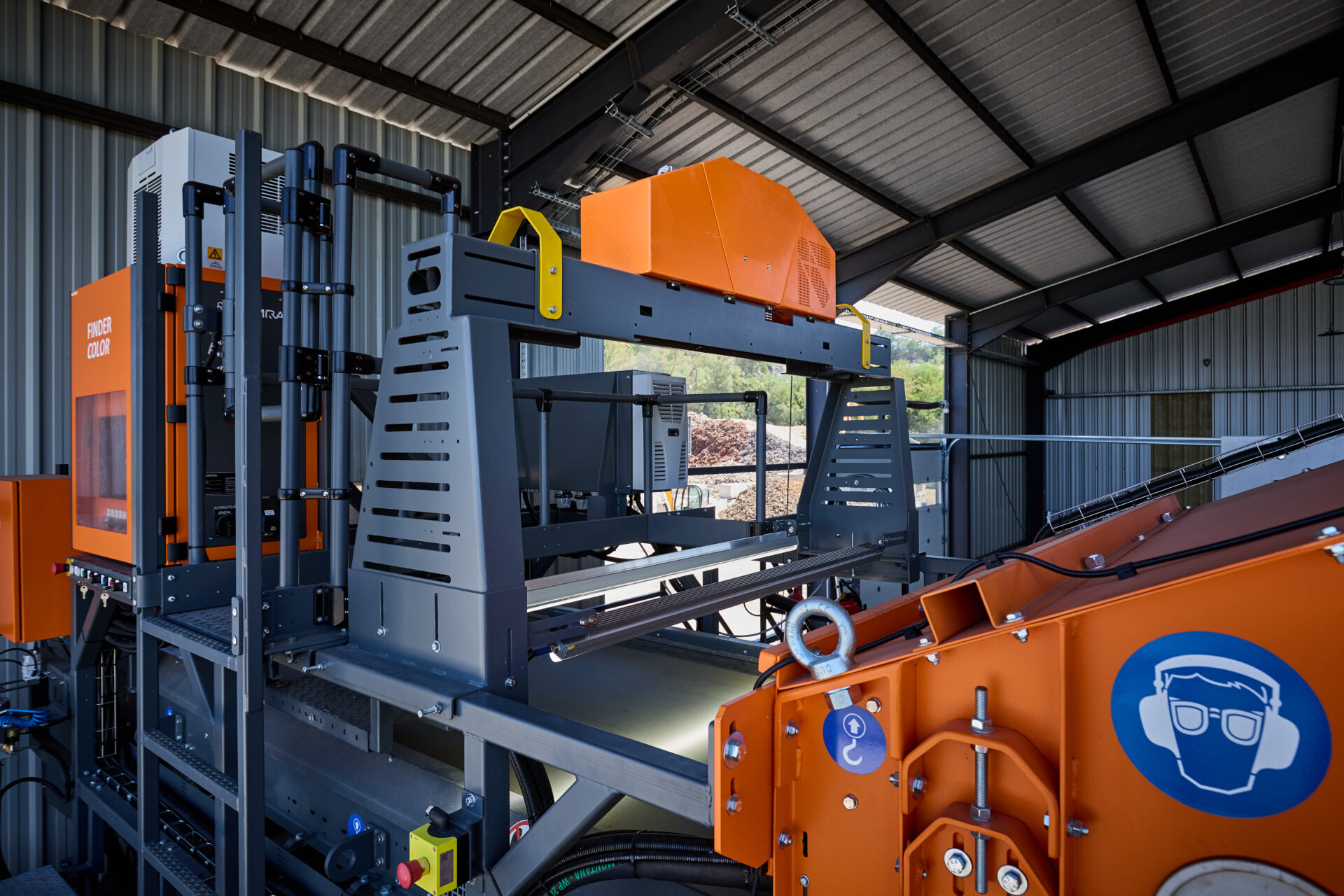
Thanks to its expertise and the integration of top-tier sorting technologies, it has experienced rapid growth in recent years. With up to 14 employees, it generated approximately €4 million in revenue in 2024, with a stated goal to double that figure as early as next year. Pushing sorting capabilities to their full potential is central to the company’s strategy, as is the integration of Tomra’s new Finder Color —an advanced color sorting solution with no comparable technology currently in operation on site.
Trimetal aimed to achieve a stainless steel fraction with over 98% purity—without relying on manual sorting. Stainless steel is generally considered difficult to clean, often contaminated by other metals. Producing a consistent, homogeneous, and clean output was a major challenge for the company to ensure competitiveness and profitability.
Beyond stainless steel, the strategic goal is to secure access to critical and strategic metals in Europe—such as copper, brass, and even precious metals—to prevent scarcity caused by large-scale exports and to ensure full traceability in the recycling process.
In 2025, Trimetal chose to install Finder Color, Tomra Recycling’s latest innovation, a high-precision color sorting system that supports a wide range of metal tasks such as recovering copper and brass from heavy metals, separating PCBs from e-scrap and cleaning stainless steel. It combines an ultra-precise RGB camera with artificial intelligence (AI) to detect, separate, and sort each particle—even if they overlap or match the conveyor belt’s color. Sorting is based on color, size, and shape.
At the Trimetal plant, the Finder Color serves as the core of the optical sorting process. It complements Tomra’s Finder unit, which was installed in 2021 and operates on a separate line with larger grain sizes to sort all metals and stainless steel. The other equipment—shredding, screening, magnetic separation, and eddy current separation— creates ideal material conditions to support high-performance sorting. The line’s configuration allows for the processing of mixed materials that are typically considered difficult, supplying end users both within France and across the EU. The electromagnetic (EM) sensor that Trimetal chose to integrate into the Tomra system further reduces plastic contamination by recovering all metals and enhancing precision in cables and stainless sorting.
Finder Color stands out for its flexibility: The system allows seamless configuration in batch or continuous flow mode and rapid switching between material fractions. It can easily switch between sorting tasks, without needing to reconfigure the line. In addition to stainless steel, the system allows TRIMETAL to also recover high-value metals—enabling the company to adapt to future demands and seize new business opportunities. This versatility reflects TRIMETAL’s core identity: the ability to process complex materials, maximize resource recovery, and return each material to its proper recovery stream.
With Finder Color, Trimetal has achieved tangible outcomes: reaching purity targets, increasing throughput to handle higher volumes, significantly reducing manual sorting, maintaining consistently stable performance, and unlocking new business opportunities.
Looking ahead, Trimetal aims to intensify the sorting of high-value non-ferrous streams—such as copper alloys, brass, and PCBs—to accelerate its move upmarket without increasing headcount or incoming tonnage.