
Numerous studies show that even these low concentrations can have ecological effects and potentially pose a risk to human health. The fact that many of these substances are continuously released into the environment is of particular concern, to which aquatic organisms are subsequently exposed, even in low individual concentrations.
Advances in analytical chemistry have detected an ever-increasing number of anthropogenic substances in the aquatic cycle. While this enhanced detection capability has improved scientific understanding, it has simultaneously increased the demands placed on environmental assessment and regulation, as detectability alone does not equate to environmental relevance or actual risk. Within this context, risk-based assessment approaches are gaining importance as a means of distinguishing between ecologically relevant contamination and concentrations of negligible concern. At the same time, it has become apparent that existing assessment frameworks are only partially capable of adequately capturing the effects of complex substance mixtures and long-term chronic exposure scenarios.
Definitions of terms and substance-based differentiation
Microplastics – also known as ‘synthetic polymer microparticles’ (SPM) – can be broadly defined as small plastic particles and fibres smaller than five millimetres in size. Over time, scientific literature has established an overarching, size-based classification system of macro-, meso-, micro- and nanoplastics, with fluid transitions between the categories. Depending on the type of polymer, density, shape and surface characteristics, these microplastics can float, remain suspended or settle within aquatic systems, thereby strongly influencing their possible transport routes, environmental fate and ecological impacts. Moreover, microplastic particles can act as vectors for other contaminants by adsorbing organic pollutants or heavy metals onto their surfaces.
Based on their origin, microplastics are classified as either primary or secondary. Type A primary microplastics are intentionally produced in small sizes, such as pellets or microbeads used in cosmetics, cleaning agents or industrial coatings. Type B primary microplastics are generated during product use, for example through tyre abrasion, washing of synthetic textiles or abrasion of paints and coatings. Secondary microplastics arise from the physical, chemical and biological degradation of larger plastic items under environmental influences such as UV radiation, precipitation and mechanical stress. In Germany, tyre abrasion alone releases over 100,000 tonnes of microplastics annually.
Micropollutants on the other hand, are comprised of a heterogeneous group of predominantly dissolved or nanoscale chemical substances that differ fundamentally from particulate microplastics. This group includes pharmaceutical residues, pesticides, industrial chemicals, endocrine-active substances and per- and polyfluoroalkyl substances (PFAS). PFAS are characterised by extremely stable carbon–fluorine bonds, rendering biological, chemical or physical degradation processes largely ineffective and leading to long-term accumulation in the environment and biota. As a result, PFAS are commonly referred to as ‘forever chemicals’ and can now be detected in almost all environmental compartments.
The term ‘micro pollutants` serves as an overarching category for anthropogenic organic substances detectable at very low concentrations. Within this group, ‘priority substances’ hold a particular status under the Water Framework Directive due to their elevated environmental or health risks and are subject to binding environmental quality standards. In addition, ‘priority hazardous substances’ are defined within the Directive, classified with the objective of promoting the long-term and complete cessation of emissions.
The continued lack of harmonised definitions for microplastics and many micorpollutants constitutes a structural deficit that hampers both scientific comparability and effective regulatory implementation.
Regulatory framework and current challenges
The regulatory landscape at both European and national levels is shaped by a complex set of directives and regulations. The Water Framework Directive obliges Member States to achieve ‘good chemical status’ and to monitor ‘priority substances’ through systematic water quality assessments. Measured concentrations are compared to environmental quality standards and, where necessary, translated into river basin management plans and programmes of measures.
The revised Urban Wastewater Treatment Directive significantly strengthens the regulatory focus on micropollutants. It mandates the introduction of a fourth treatment stage for large wastewater treatment plants by 2045, encompassing advanced technologies such as ozonation, activated carbon filtration and membrane processes designed to remove pharmaceutical residues, endocrine disruptors and industrial chemicals. In addition, the directive introduces extended producer responsibility, requiring producers of potential pollution sources – particularly in the pharmaceutical and chemical sectors – to contribute to the financing of wastewater treatment. This represents the first explicit application of the polluter-pays principle to micropollutants. However, recent studies indicate that the adopted cost-allocation model lacks scientific justification.
This framework is complemented by the EU Microplastics Regulation and the REACH Regulation. The Microplastics Regulation prohibits products containing intentionally added microplastics from being placed on the market, including cosmetics, detergents and sports pitch infill materials. Manufacturers are required to label products, report release quantities and provide disposal guidance, with transitional periods ranging from four to twelve years. REACH further strengthens substance regulation through mandatory risk assessments and registration obligations for chemical producers.
At national level in Germany, the Water Resources Act provides the central legal framework for water protection, while the Surface Waters Ordinance and the Groundwater Ordinance establish environmental quality standards (EQS) and monitoring lists for emerging pollutants such as microplastics. The Federal Micropollutant Strategy (SZB) focuses on pharmaceutical residues, pesticides and industrial chemicals, and follows a precautionary, source-oriented approach.
Despite this extensive regulatory framework, only around 29 % of European surface waters currently achieve good chemical status. Divergent implementation levels across Member States, inconsistent definitions and unresolved issues related to cost allocation – particularly under extended producer responsibility – continue to impede effective implementation. Moreover, the concentration on a limited number of sectors has been criticised for failing to reflect the diversity of actual emission pathways.
Sources and pathways into the aquatic environment
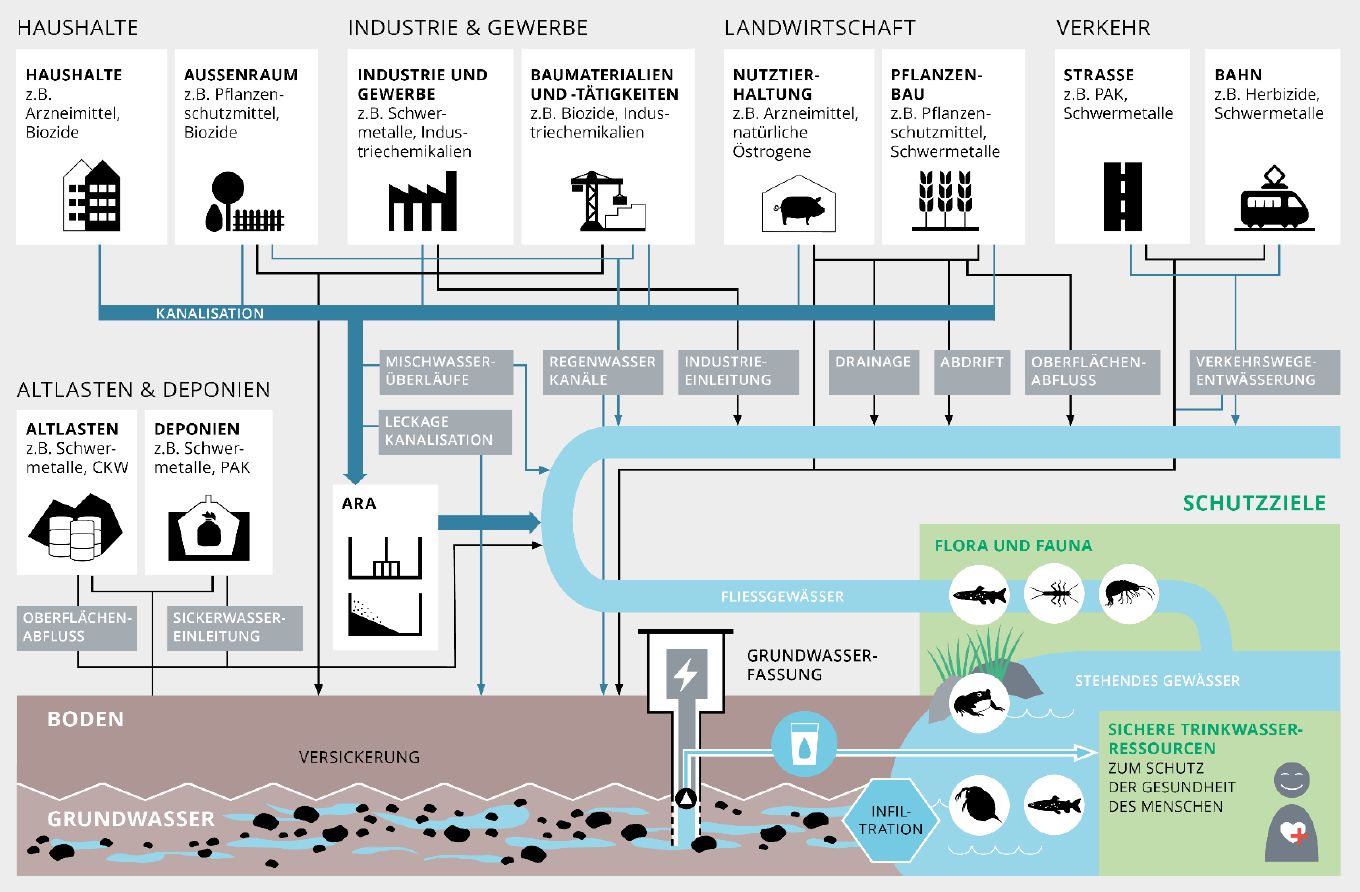
The pathways through which microplastics and micropollutants enter aquatic environments are diverse and complex. Municipal wastewater treatment plants act as a central hub, as they consolidate wastewater from households, industry, healthcare and agriculture. It is estimated that approximately 92 % of micropollutant inputs originate from municipal wastewater streams, as many persistent substances are not fully removed by conventional treatment stages. In most cases, it is not possible to assign substances unequivocally to individual source sectors, as many originate from multiple applications.
A diffused range of sources contribute to overall contamination levels, with agricultural land representing a major source of pesticides and nutrients, road traffic releasing significant quantities of microplastics through tyre and brake abrasion, and atmospheric depositions as well as stormwater runoff complicating targeted control. These diffused pathways largely evade traditional regulatory instruments and therefore pose a particular challenge to water protection efforts.
Risk assessment and environmental significance
A sound risk assessment forms the basis for effective measures to reduce mircopollutants. In addition to measured concentrations, factors such as persistence, bioaccumulation, toxicity and exposure are decisive. For assessment purposes, parameters such as PNEC values (Predicted No Effect Concentration), NOEC values (No Observed Effect Concentration), and environmental quality standards (EQS) are used. Levels of trace substances exceeding these thresholds indicates a need for potential regulatory action. It should be noted that environmental quality standards are generally derived on a substance-specific basis, and interactions between substances have so far hardly been considered.
Reliable data is already available for certain substances. For example, the active pharmaceutical ingredient diclofenac exceeds the PNEC value of 0.05 μg/L in many water bodies and has been shown to cause chronic damage to fish and other aquatic organisms. However, long-term toxicological data is still lacking for numerous other substances, particularly regarding chemical mixtures and their cumulative effects, which complicates the derivation of reliable limit values.
Wastewater treatment and technical solutions for contaminant elimination
Conventional wastewater treatment plants with primary to tertiary treatment stages are capable of mechanically and biologically capturing a large proportion of particulate microplastics. Elimination rates of up to 99.9% are achieved, particularly when fine screens are used. At the same time, particles accumulate in the sewage sludge, which is frequently used for agricultural purposes, thereby opening a pathway for these substances into soils and food chains. In this context, the disposal and recovery of sewage sludge is becoming increasingly important for precautionary water protection.
Persistent micropollutants, by contrast, are only insufficiently removed in conventional treatment stages. The fourth treatment stage therefore represents a key technological enhancement. Processes such as ozonation, activated carbon filtration and membrane technologies can achieve removal efficiencies exceeding 90 %, albeit at the expense of increased costs and energy demand. Hybrid systems combining physical, chemical and biological processes are increasingly discussed as promising future solutions.
Integrated solution approaches
Sustainable water protection requires an integrated, cross-sectoral approach. Source control represents the most effective lever, for example through microplastic-free product design, adapted agricultural practices and emission-reduced transport systems. Technical measures in wastewater treatment remain indispensable but must be complemented by fair, risk-based financing mechanisms and greater harmonisation of definitions and environmental quality standards. In the long term, regulatory frameworks need to be more closely aligned with actual risks to human health and the environment. Achieving sustainable water protection ultimately depends on close cooperation between water utilities, industry, agriculture, science and policymakers. Only through such an integrated approach can the ambitious objectives of EU water policy be met by 2045 and can clean water resources be secured for future generations.