
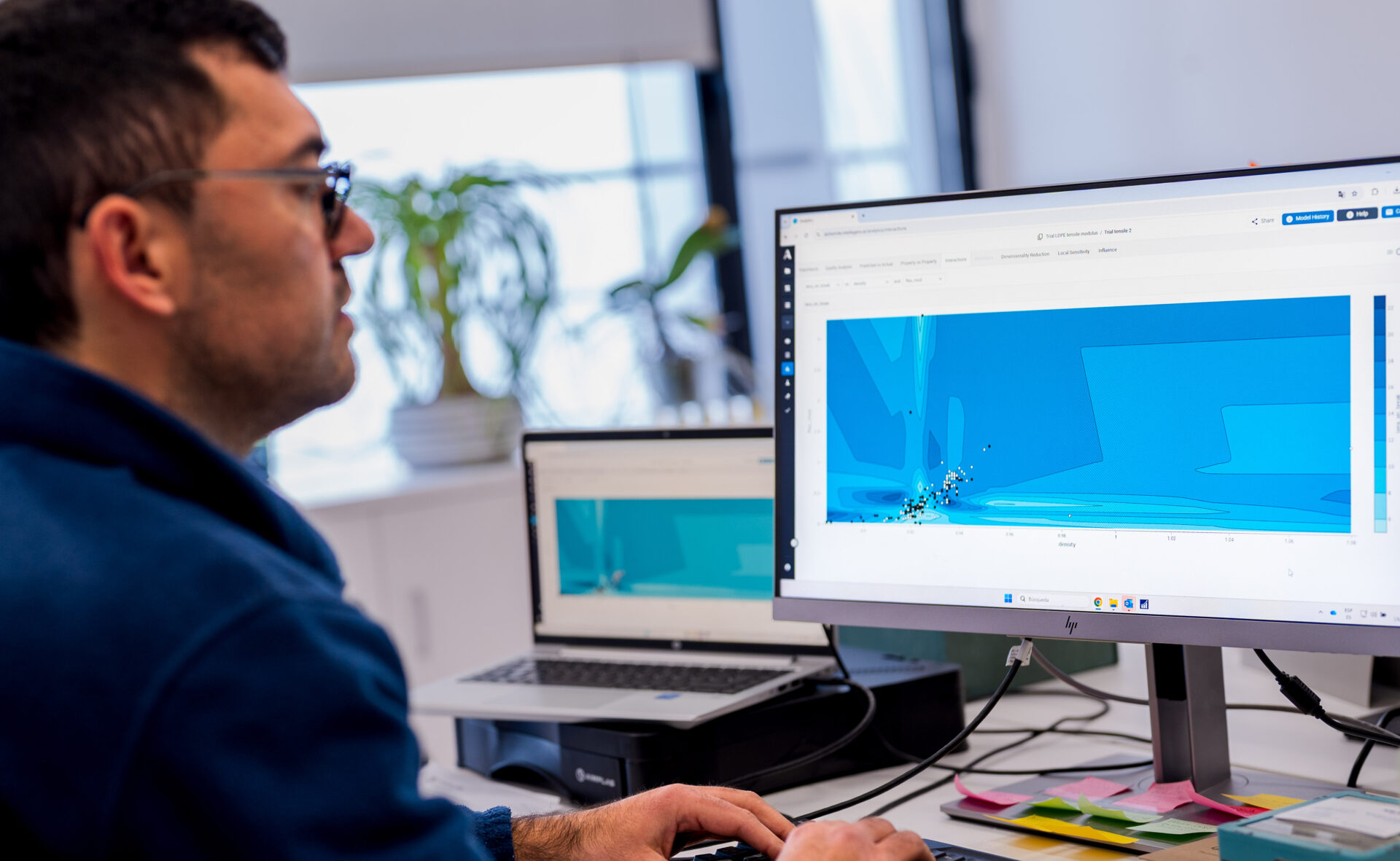
The project aims to support material development by enabling data-based predictions of relevant properties and by improving efficiency in research and development processes.
The project is focused on the development of predictive models capable of estimating mechanical, thermal and physical material properties at an early stage of development. By using data-driven approaches, POLY-ML enables faster and more reliable decision-making during formulation design. This reduces the need for extensive experimental testing and contributes to shorter development cycles, lower material consumption and improved process traceability.
POLY-ML is funded by the Valencian Institute of Competitiveness and Innovation and the European Regional Development Fund. Project partners include Tyris AI, a provider of artificial intelligence solutions for industrial applications, and FAPERIN, a plastics processing company specialising in polypropylene injection moulding for the automotive sector. FAPERIN supplies process and material data for model training and validation, while Tyris AI contributes expertise in the industrial implementation of machine learning technologies.
A central objective of the project is the development of a software tool that enables the creation and use of predictive models without the need for programming skills. This approach is intended to lower barriers to adoption and support the integration of artificial intelligence into plastics processing and materials development.
The project also addresses sustainability and occupational safety aspects. By reducing trial-and-error experimentation, POLY-ML contributes to lower laboratory waste volumes and reduced use of chemical substances. At the same time, it limits employee exposure to potentially hazardous materials during testing procedures. From an economic perspective, the project supports the competitiveness of the plastics industry in the Valencian Community and promotes the development of digital competencies within the regional industrial ecosystem.
POLY-ML is aligned with the RIS3-CV regional innovation strategy, particularly in the areas of digitalisation, sustainability, circular economy and collaboration between research institutions and industry. Through this alignment, the project contributes to the application of artificial intelligence in materials engineering and industrial plastics development.