
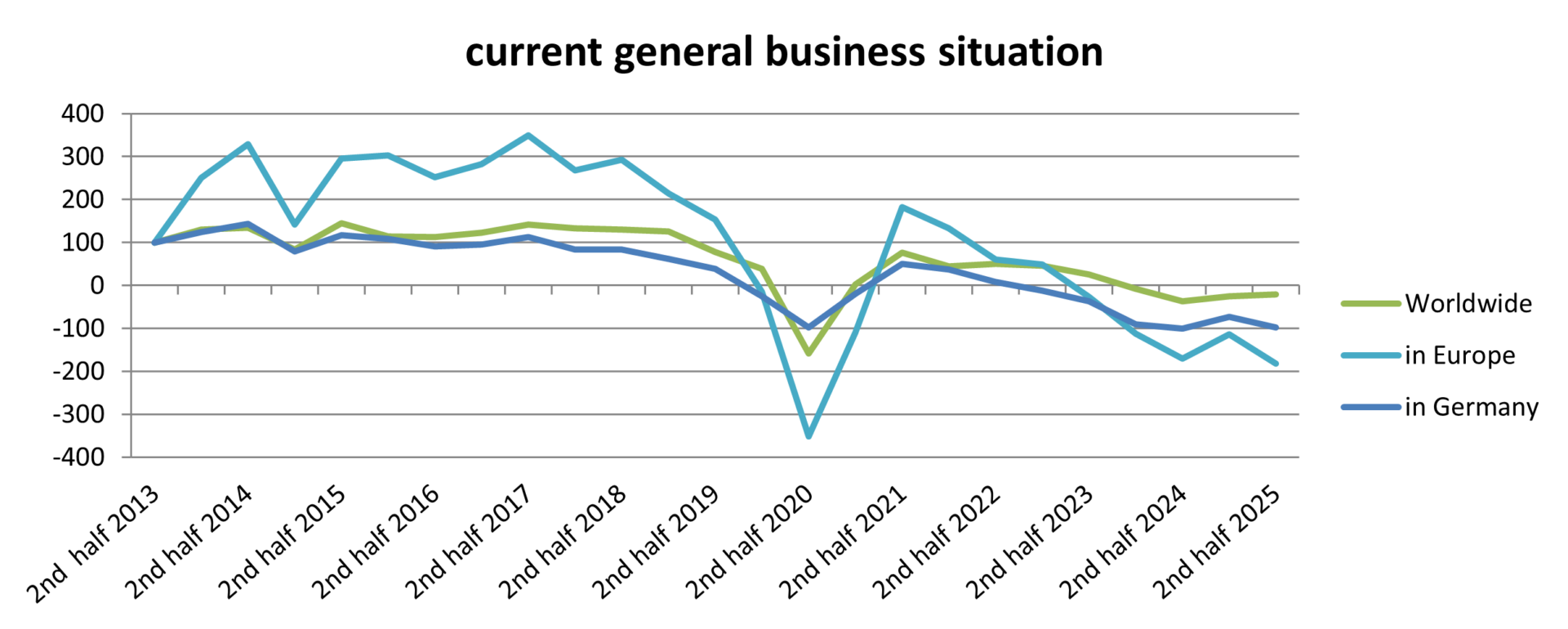
The latest results indicate a renewed deterioration in the assessment of the current business situation. While the previous survey showed an improvement across all regions, the current evaluation for Europe and Germany has shifted into negative territory. Only the global assessment remains slightly positive. Companies assess their own business situation more critically than the general market environment, with negative ratings across all regions surveyed.
These findings correspond with broader analyses of the European composites market. Since 2021, market volume has declined by around 20 percent. Increased competition from Asia and the United States, the loss of export markets and the growing supply of domestic production in former target regions are contributing factors. Trade barriers, including US customs policy, are adding further pressure. In addition, structural weaknesses in key application industries, particularly transport and automotive, continue to affect demand. Other sectors such as construction, infrastructure, and electrical and electronics have so far been unable to offset the decline.
The composites industry remains closely linked to overall economic development. Economic conditions in Europe, and particularly in Germany, continue to be subdued. Government initiatives, including the €500 billion German federal investment programme for infrastructure, climate protection, digitalisation and education, have not yet translated into measurable market stimulus.
Expectations for the near future remain cautious. In Europe and Germany, most respondents do not anticipate short-term improvement. Approximately 80 percent expect the situation to remain unchanged or deteriorate further. Globally, expectations are somewhat more positive, although only around one in five respondents foresee an improvement.
The investment climate has weakened compared to the previous survey in the second half of 2025. The share of companies planning or considering investments in machinery and equipment has fallen from 50 percent to 38 percent. Personnel planning presents a mixed picture. While the proportion of companies intending to increase their workforce has risen slightly from 15 percent to 18 percent, the share expecting workforce reductions has grown more significantly, from 27 percent to 36 percent. Nevertheless, more than one-third of respondents plan to expand their engagement in the composites sector overall.
Expectations vary across application industries. Mobility remains the largest field of application but continues to face structural challenges in Europe and Germany. Growth impulses are primarily expected in aviation and in construction and infrastructure. Following several years of declining construction volumes, moderate growth is forecast in Germany from 2026 onwards, which could support demand for composites in this segment.
With regard to growth drivers, the survey indicates a gradual shift. Carbon fibre-reinforced plastics and glass fibre-reinforced plastics are cited less frequently as individual drivers, while composites as a broader material group are gaining relevance. Regionally, Asia is increasingly regarded as the main source of growth momentum. Germany is perceived as losing importance, while Europe overall shows a slight increase in relevance. North America remains at a comparatively low level.
The Composites Index has returned to negative territory in most categories after a temporary improvement in the previous survey. Only expectations regarding the future general business situation remain marginally positive.
Despite the current market environment, composites continue to offer a wide range of technical properties that support their use in multiple application areas. However, market development remains dependent on macroeconomic and industrial conditions. Further progress will depend on innovation, access to new market segments and the implementation of industrial policy measures.