
This briefing is based on a 2026 technical report by the European Topic Centre on Circular Economy and Resource Efficiency. From more than 460 publications published between 2020 and March 2025, 131 studies with quantifiable and methodologically robust results were analysed. The review assesses both relative emission reductions, expressed as percentage changes compared to business-as-usual scenarios, and absolute reductions in gigatonnes of CO2 equivalent up to 2050.
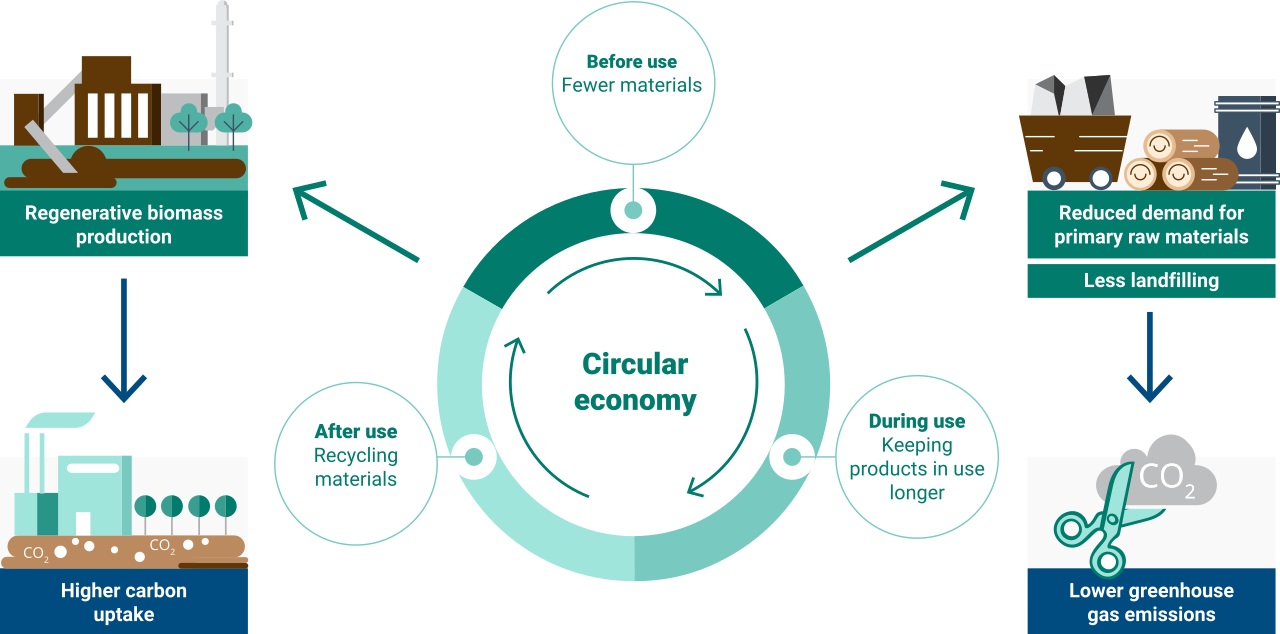
Circular economy measures reduce greenhouse gas emissions primarily by lowering demand for primary raw materials. Emissions from extraction and processing account for around 55% of global greenhouse gas emissions. Measures before use, such as circular design and material substitution, reduce resource inputs. During use, extending product lifetimes through repair and reuse limits demand for new materials. After use, recycling and improved waste management decrease primary extraction and reduce methane emissions from landfills.
Across all studies, reported mitigation potentials range from 2% to 99%, reflecting differing assumptions and methodologies. Aggregated results indicate an average global reduction potential of approximately 33%, representing a theoretical estimate.
In relative terms, waste management shows the highest average mitigation potential at 52%. Construction and buildings follow with 48%, while transport, industry and agriculture show lower percentage reductions. In absolute terms, agriculture and food systems offer the highest global potential, with reductions of up to 7.3 gigatonnes of CO2 equivalent by 2050, followed by construction and buildings with up to 6.8 gigatonnes. Differences between relative and absolute results reflect varying emission intensities across sectors.
The review also indicates that demand-side measures, such as dietary change and reduced floor space, can deliver substantial absolute emission reductions, although results vary widely depending on assumptions. Recycling and waste treatment dominate the literature, while upstream measures in product design, reuse and material substitution are less frequently assessed.
Overall, the evidence confirms that the circular economy can support climate mitigation. However, significant variation in methods, system boundaries and scenarios limits direct comparability between studies. Greater methodological transparency and harmonised assessment frameworks are required to improve the robustness and comparability of future analyses.