
The IAA, presented on 3 March 2026, aims to support the decarbonisation of European industry. However, the current proposal does not position public procurement as a central policy instrument for accelerating the market uptake of low-carbon materials. ECOS argues that the proposed quotas for low-carbon steel and concrete are significantly below current market potential and therefore provide limited stimulus for the expansion of existing clean production technologies.
Demand-side measures such as public procurement are widely regarded as an important mechanism for supporting industrial decarbonisation by creating stable markets for low-emission products. According to ECOS, the limited role assigned to procurement in the IAA may allow conventional, carbon-intensive materials to remain dominant in the construction sector for an extended period. This could increase uncertainty for companies investing in low-carbon production technologies and slow the development of emerging industrial supply chains.
The proposal also introduces product labelling schemes for key industrial materials, including steel and concrete. However, the regulatory framework does not yet define detailed criteria or binding implementation timelines. Responsibility for the development of these labels is largely transferred to other legislative frameworks, including the Construction Products Regulation (CPR) and the Ecodesign for Sustainable Products Regulation (ESPR). Industry observers note that this approach may delay the introduction of harmonised standards for low-carbon materials.
In addition, ECOS points to recent delays in the development of steel-related requirements under the ESPR framework. The IAA proposal does not appear to accelerate this process, while for concrete the legislation relies primarily on procedures under the CPR. These processes have previously been criticised for lengthy implementation timelines and limited progress on sustainability requirements.
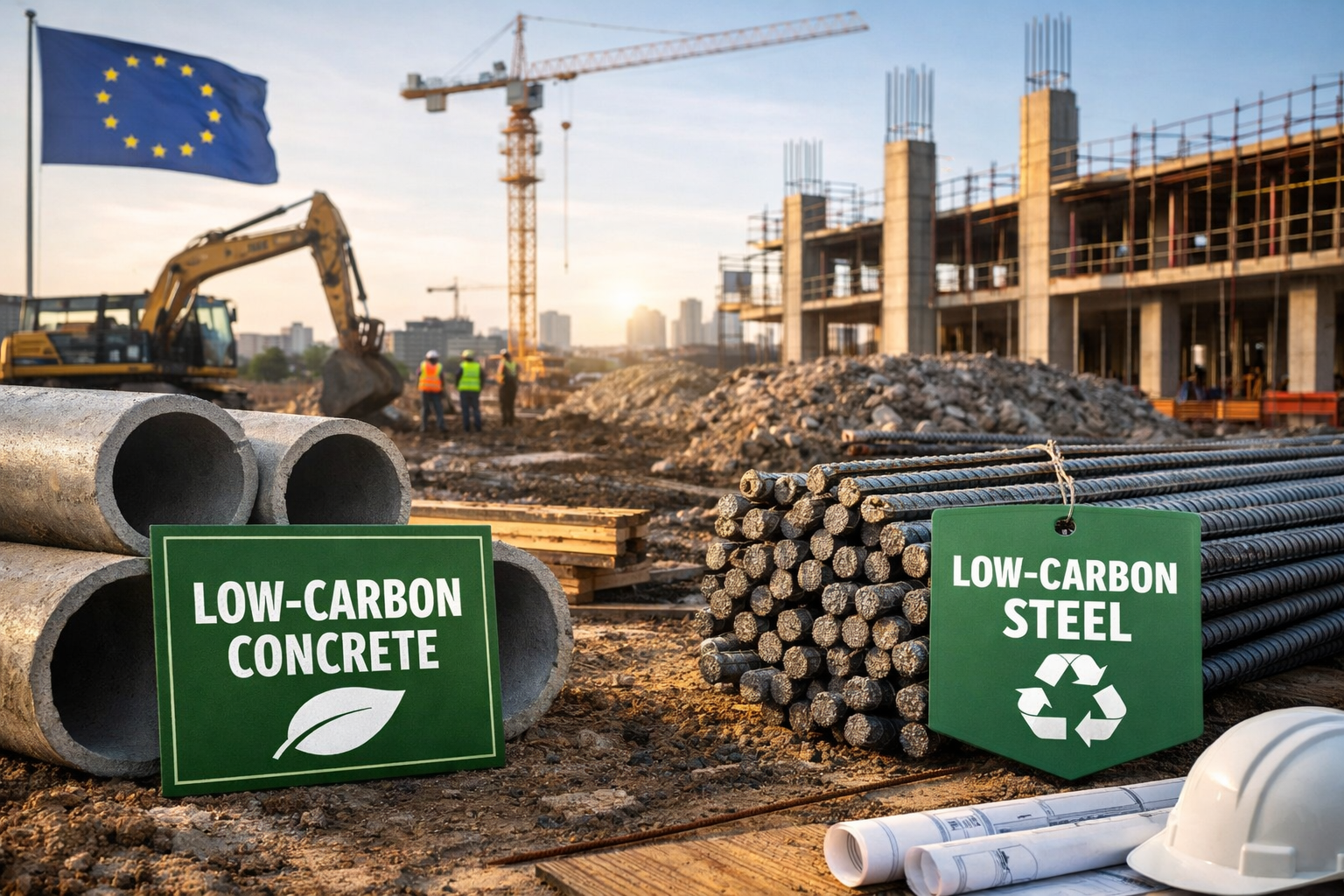
The proposed quotas for low-carbon materials are also considered comparatively low relative to available technologies. Under the current proposal, a 25 per cent quota for green steel in public procurement would affect less than four per cent of overall EU steel demand, while a five per cent quota for low-carbon concrete would cover roughly 1.5 per cent of the market. According to ECOS, several European manufacturers already supply lower-emission steel and concrete products, and the technologies required for wider deployment are available.
The proposal further states that public procurement requirements for low-carbon steel and concrete would apply from 1 January 2029. The regulation does not outline a longer-term trajectory for progressively increasing these requirements towards full decarbonisation. Analysts note that the absence of clear milestones may reduce planning certainty for companies investing in low-emission materials.
Public infrastructure projects account for a substantial share of construction activity in the European Union. As construction materials such as steel and concrete contribute significantly to industrial greenhouse gas emissions, procurement policies are widely considered a potential lever for accelerating the transition towards lower-carbon production processes. According to ECOS, stronger procurement requirements could support earlier market uptake of emerging technologies and contribute to emission reductions in the construction sector.