
The proposal introduces designated industrial acceleration areas and provisions for public procurement aimed at stimulating demand for lower-carbon industrial materials. Public authorities would be required to include minimum shares of low-carbon products in certain procurement processes, including 25% for steel and aluminium and 5% for concrete and mortar.
According to environmental organisations, the measures are not yet accompanied by clear definitions of “low-carbon” production, binding decarbonisation timelines or specific limitations on fossil-based industrial technologies. They argue that the effectiveness of the policy framework will depend on predictable regulatory signals, including carbon pricing mechanisms and clearly defined phase-out pathways for fossil fuels in energy-intensive sectors.
The procurement quotas introduced in the proposal are viewed by stakeholders as a first step toward creating lead markets for lower-carbon materials. However, the scale of the quotas is considered limited in relation to current production patterns. Approximately 45% of steel produced in the European Union already originates from electric arc furnaces, which generally generate lower emissions than primary steelmaking routes. As a result, a 25% procurement requirement could largely reflect existing production shares rather than stimulate additional decarbonisation of primary steel production.
A similar situation applies to the proposed 5% quota for low-carbon concrete. Industry analysts note that such a level would cover only a small proportion of available low-carbon cement types and would likely have limited impact on reducing the clinker-to-cement ratio across the EU cement sector, a central parameter in lowering emissions from cement manufacturing.
The Commission did not present the previously discussed voluntary label for low-carbon steel. Instead, further regulatory work is expected within the framework of the Ecodesign for Sustainable Products Regulation (ESPR). The Ecodesign framework already applies in other product groups and assesses environmental performance across multiple indicators, not only greenhouse gas emissions. Nevertheless, the absence of a concrete labelling scheme has been criticised by some stakeholders who argue that clearer definitions and product standards would provide stronger guidance for investment decisions and procurement policies.
The proposal also defines “energy-intensive decarbonisation projects” as projects that significantly and permanently reduce CO₂ emissions to the extent technically feasible. Critics argue that the definition remains too general and lacks measurable benchmarks. Without quantified emission-reduction criteria aligned with EU climate targets, incremental efficiency improvements in fossil-fuel-based processes could potentially qualify as decarbonisation projects.
Another element of the Act is the creation of national industrial acceleration areas in which projects may be automatically classified as strategic and in the public interest. Within these areas, environmental assessments could be conducted at the level of the entire zone rather than for each individual project. In contrast to renewable acceleration areas established under EU energy legislation, the proposed industrial zones are not restricted to specific technologies.
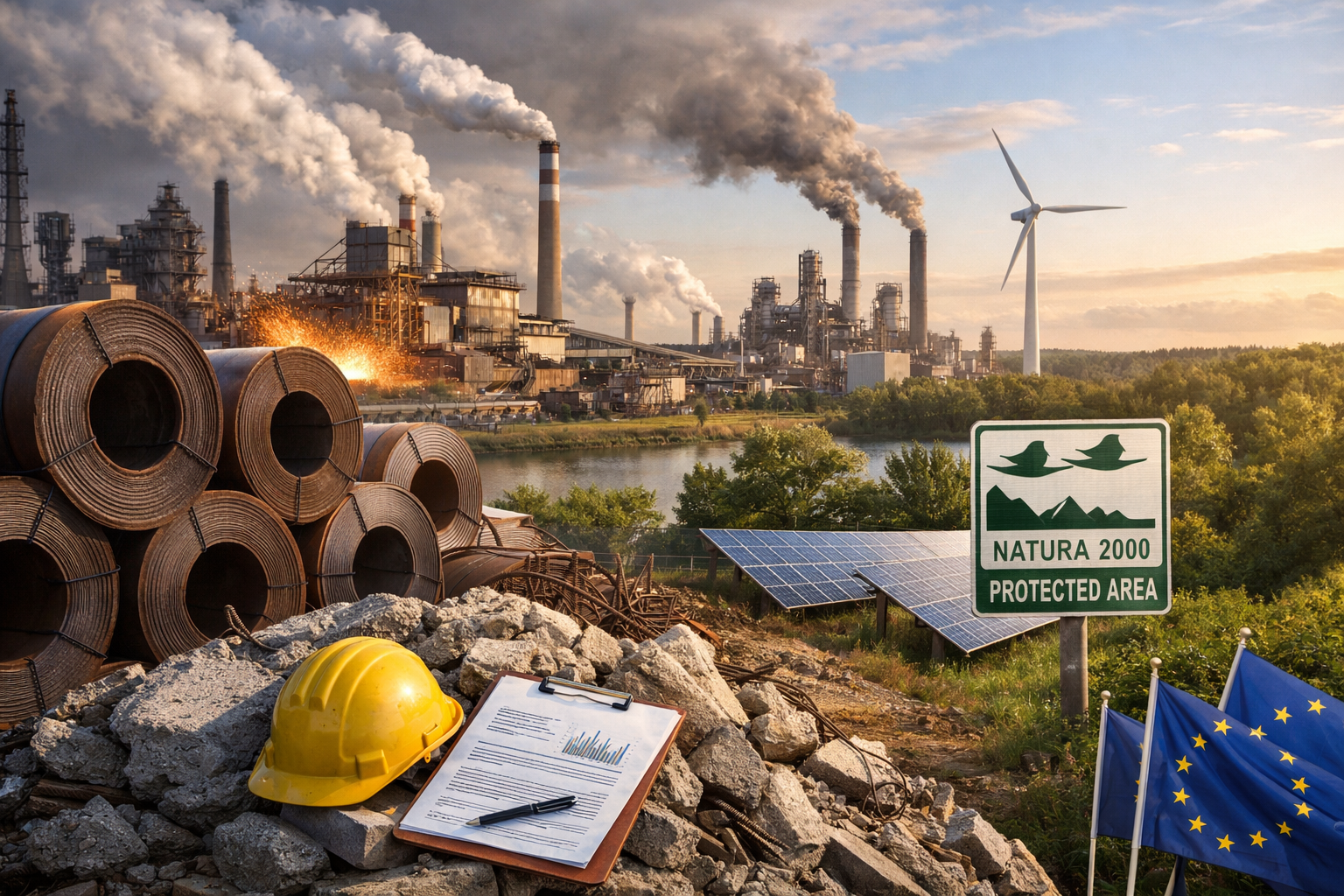
Environmental organisations warn that aggregated environmental assessments could limit the ability to evaluate project-specific impacts and mitigation measures. The proposal does not explicitly exclude Natura 2000 sites or nationally protected areas, although these locations are expected to receive lower priority. Stakeholders note that insufficient environmental safeguards could lead to legal challenges that might delay project implementation.
The Act also aims to strengthen European lead markets and introduce “Union origin” criteria in public procurement through amendments to the Construction Products Regulation. However, exemptions remain in the framework, including a clause allowing contracting authorities to waive requirements if they lead to disproportionate cost increases of more than 25%. According to industry observers, such provisions may limit the practical application of green public procurement rules.