
Additional objectives include lowering defect rates by 50–80% and extending the fatigue lifetime of hydroturbine components by 50–80%. These indicators define project-level targets across multiple use cases and are intended to support more resource-efficient manufacturing systems.
Project Scope and Technological Approach
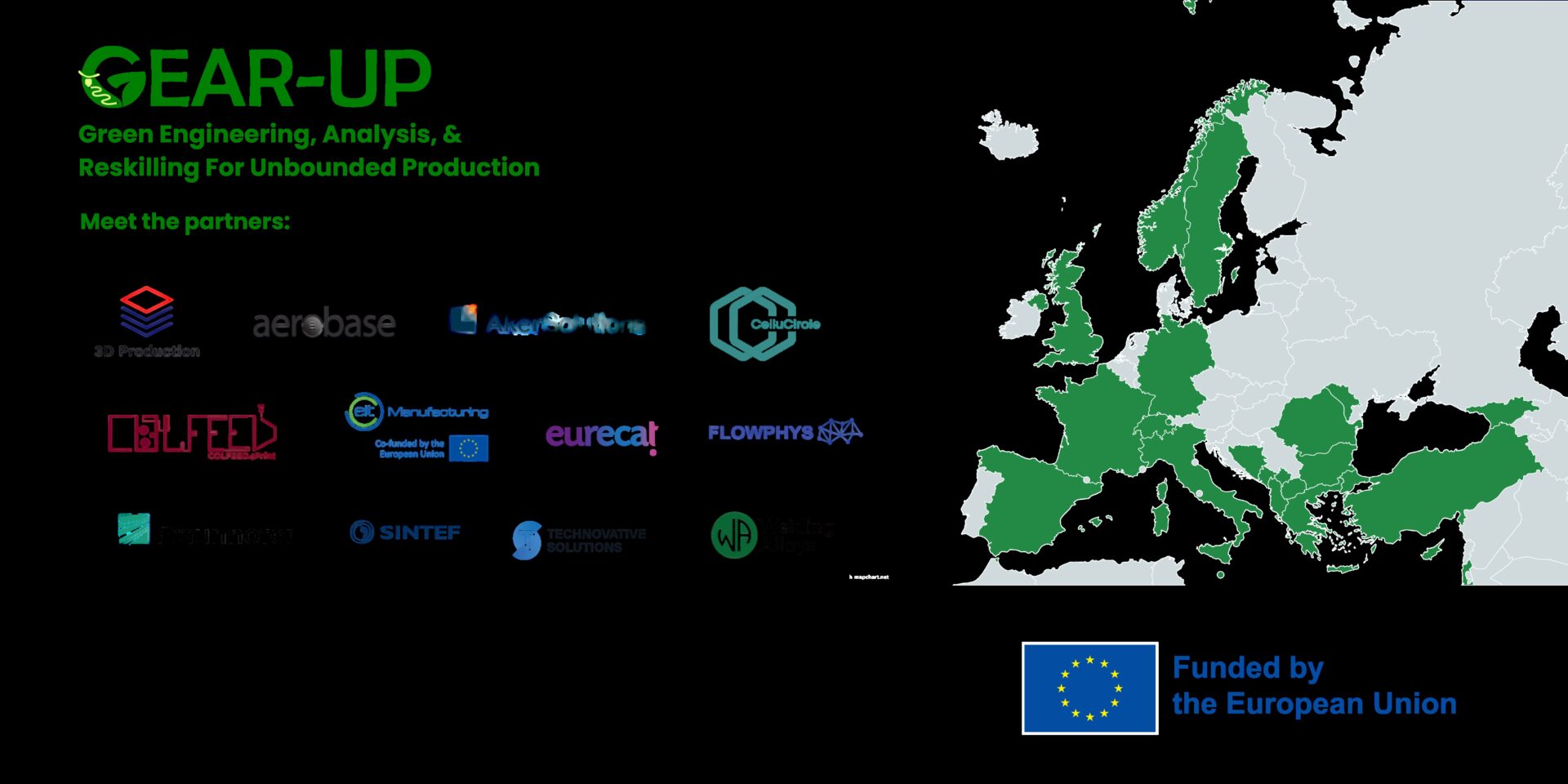
Launched in October 2024 as a Coordination and Support Action under Horizon Europe, GEAR-UP has a budget of €5.99 million. The project combines additive manufacturing with AI-supported life-cycle assessment (LCA) and simulation-based design. It focuses on recycled stainless steel, aluminium alloys and fibre-reinforced plastics. The aim is to address variability and traceability challenges that have limited the industrial use of secondary raw materials.
Digital tools developed within the project include AI-based LCAs for additively manufactured components, simulation models that incorporate material variability, and structured data models for lifecycle tracking. Simulation-driven design methods are used to optimise components prior to production. These approaches support reduced reliance on primary raw materials and contribute to lower energy consumption and greenhouse gas emissions.
Material Efficiency and Environmental Impact
The use of recycled metals reduces dependence on primary ores and lowers both energy demand and CO₂ emissions. Recycling of textiles and composite materials contributes to reduced water consumption and emissions. The project integrates these material streams into manufacturing processes to improve overall resource efficiency.
Industrial Use Cases
Several industrial applications demonstrate the feasibility of circular manufacturing approaches. Robotic grippers produced via laser-based powder bed fusion (PBF-LB) are manufactured from recycled aluminium (ALSi10Mg) as an alternative to titanium. The components maintain functionality despite minor design adaptations.
In the energy sector, recycled 13-4 stainless steel is applied in directed energy deposition (DED-LB/W) processes to repair Pelton turbine components. Additive repair extends component lifetime and reduces material consumption compared to replacement. The same process can also be used for new component production.
In the field of composites, recycled PET is processed into filaments reinforced with carbon fibres and titanium dioxide. These materials are used for additively manufactured components such as cogwheels for electric snowmobiles, offering durability under demanding environmental conditions.
Challenges in these applications include controlling impurities, managing powder particle size distribution and addressing variations in chemical composition.
Industrial and Sectoral Relevance
The project addresses stakeholders across the manufacturing value chain. Original equipment manufacturers can improve product durability while reducing resource use. Technology providers gain access to digital tools for process optimisation. Research institutions benefit from validated datasets, while policymakers receive empirical evidence to support circular economy strategies.
Workforce Qualification
GEAR-UP includes training programmes aimed at developing skills for circular manufacturing. The curriculum covers simulation, digital engineering, system integration, AI-based LCA, additive manufacturing standards and circular design principles. The training focuses on the use of recycled metals and polymers in additive processes, with emphasis on traceability and environmental performance.
Outlook for Circular Manufacturing
GEAR-UP demonstrates how circular manufacturing CO₂ reduction can be implemented through the integration of digital tools, recycled materials and advanced production technologies. The project links environmental performance with industrial application and workforce development, providing a framework for scaling circular manufacturing approaches in sectors such as energy, mobility and robotics.