
AI-supported material classification
The systems NIR-Ai and OBJECT-Ai are designed for the classification of demanding material streams. By applying artificial intelligence, materials can be identified and separated with higher precision, particularly in cases where conventional sensor technology reaches its limits. This contributes to stable sorting processes, reduced material losses and improved recyclate quality.
Sorting of carbon-black plastics
With VARISORT+ CARBON BLACK, Sesotec introduces a system for sorting carbon-black plastics. Conventional near-infrared technologies are often unable to detect these materials. The integrated MIR sensor technology enables reliable identification and separation of carbon-black polymers. This supports the production of high-quality recyclates and improves process efficiency in plastics recycling.
Flexible sensor integration
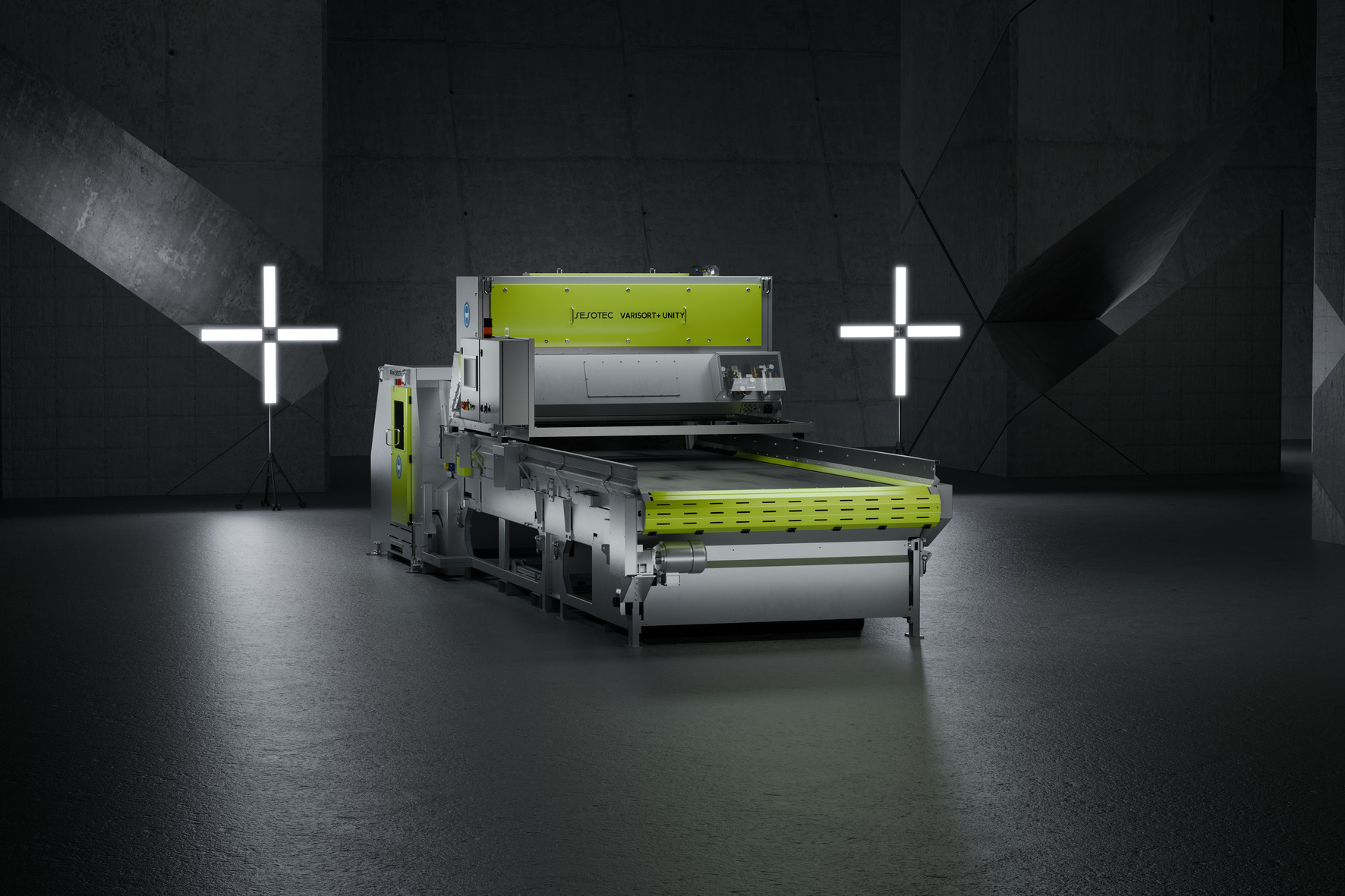
The VARISORT+ FLEX measurement bridge allows integration of sensor technology into existing sorting systems. The system is available both as a complete solution (VARISORT+ UNITY) with conveyor and ejection unit and as a standalone sensor module.
During operation, the system continuously analyses material composition at various points. Real-time data on material and colour distribution enables immediate adjustments to the sorting process. The system is designed for continuous operation under demanding conditions and requires limited maintenance. Existing plants can be upgraded without complete replacement.
Modular system architecture
The VARISORT+ system is based on a modular design. It can be configured for applications such as plastics, WEEE, metals or films. Depending on requirements, it can be integrated into existing conveyor systems, installed as a complete unit or adapted for specific applications such as VARISORT+ WEEE or VARISORT+ FILM.
Glass sorting with three fractions
For glass recycling, KRS Recycling Systems GmbH presents the SPEKTRUM+ 3S sorting system. The system enables separation into three fractions and is designed for flexible use in glass processing. Detection accuracy remains stable even with fine glass fractions.
Fast valve technology and image processing reduce false detections and material losses. The optional Dual-Sensor System C-C improves detection performance, particularly for dark glass and complex material streams. The system is suitable for both dry and wet applications due to its free-fall detection principle.
The modular sensor concept allows system expansion and adaptation. In addition, the SPEKTRUM+ BASIC version is available as a non-expandable entry-level solution.
Focus on practical applications
The technologies presented are developed with regard to operational requirements in recycling processes. The focus lies on reliable detection, flexible system integration and consistent material quality. The application of AI-based sorting technologies aims to support efficient processing of secondary raw materials and improve resource recovery.
Hall B5, Booth 415