
Since 1958, thousands of records in all sorts of colour variations have been produced every day west of Amsterdam. To ensure that not a single gram of the precious PVC plastic is wasted, Record Industry recycles production waste directly on site using shredding technology from Weima and Wanner.
While many pressing plants had to close at the end of the 1990s due to the triumph of the compact disc (CD), the record industry has managed to remain successful in the music business to this day. This is now paying off, as records have once again become a sought-after medium in recent years, which is not only appreciated by music lovers. In addition to the nostalgia and collector’s value, the quality of the analogue sound is increasingly preferred.
The company’s manufacturing process proves that supposedly outdated technology can pursue modern sustainability goals. Record Industry sees itself as a full-service provider. Artists can record and mix music directly in the company’s own recording studio. Next, the audio is cut into either a lacquer disc or copper plate (DMM) using a cutting lathe, which translates the audio signal into a modulated groove. This master is then processed through several steps in a galvanic (electroplating) process to create stampers, metal molds that are used to press the grooves into vinyl, producing the final record. So-called pucks (similar in shape to those used in ice hockey) made of special PVC are used in the pressing process. The pucks are then shaped into thin records using pressure and heat. After a short cooling period, they are placed in fully automated paper sleeves for protection. The final step is packaging in the respective covers and sleeves. The record is ready to be sold and played.
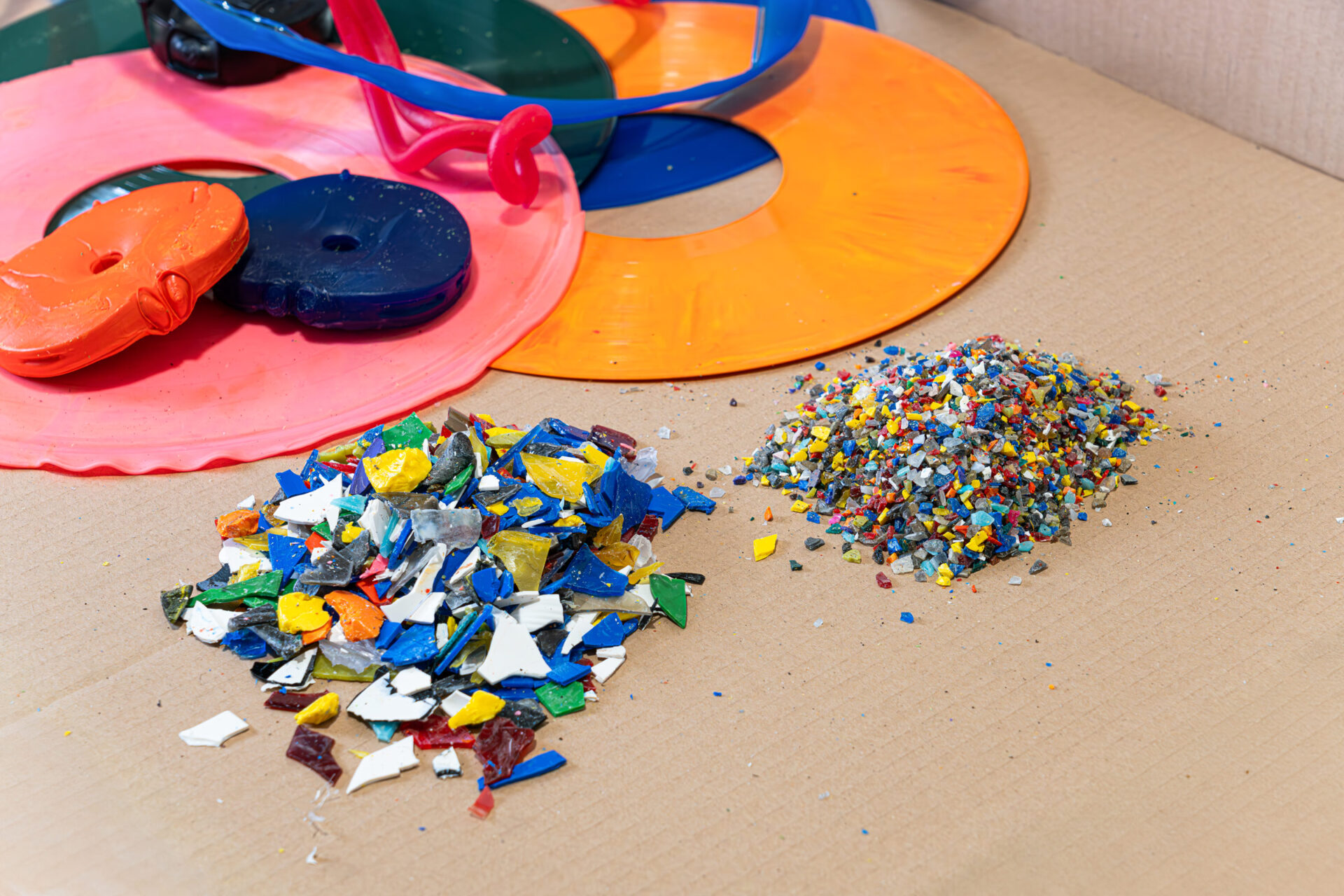
During each pressing process, an approx. 20 mm wide protrusion of PVC material – i.e. the remainder of the puck – is created on the outside due to the process. This is sheared off, giving the record its final circular shape. Next to each of the almost 40 pressing machines is a compact C-series granulator from Wanner. The production waste is automatically discharged from the pressing machine and transported into the granulator’s hopper. Within seconds, the offcuts are shredded into flakes approx. 4 mm in size and fed to the extruder via a mixing chute. This results in no waste, as the edge trimmings are processed directly inline.
Occasionally, pucks or individual records do not meet Record Industry’s quality requirements. As the pucks are too massive and the records too large for the small granulators, they have to be processed separately. Record Industry therefore set up an additional recycling line in the building next to the pressing machines. A Weima WLK 4 single-shaft shredder was put into operation there at the end of 2024 for shredding predominantly mixed PVC residues. Material can be loaded manually or by forklift from big bags via a conveyor belt. The Weima shredder pre-shreds the PVC to approx. 25 mm flakes before it is re-shredded to approx. 4 mm granulate via a further conveyor belt with metal detector in a Wanner granulator of the Dynamic series. To improve the processability of the material, the resulting recyclate is fed through a dedusting system to remove the fine dust from the ground material.
The end product is high-quality PVC flakes that can be reused in the record pressing production process. The colourful mixture of flakes creates an individual marbled coloration during pressing. Record Industry is proud to now have a 100% recycled product in its range thanks to these colourful records.