
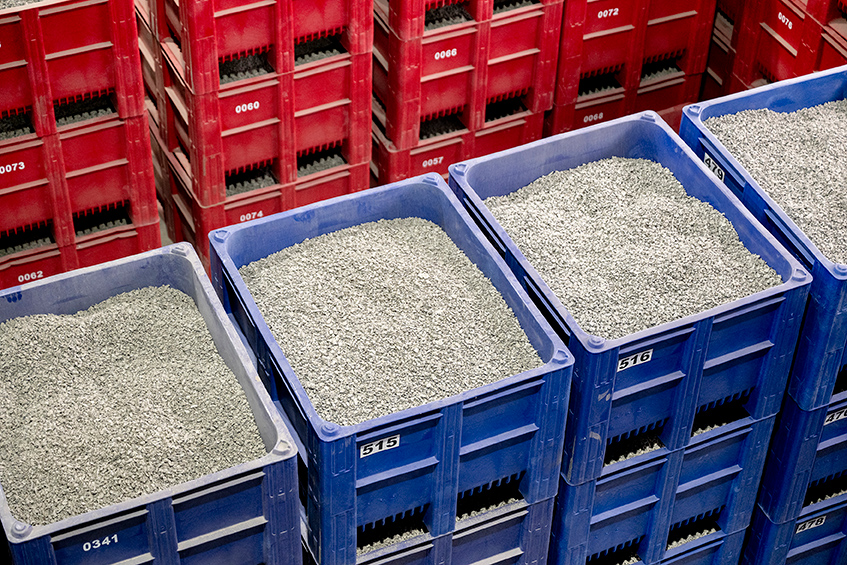
This contains significant quantities of valuable metals such as aluminium, copper, brass, and stainless steel. To keep these valuable resources in circulation, MDSU has invested in a state-of-the-art facility with X-ray technology and is now setting new standards.
Commissioned at the end of 2024, the plant at the Magdeburg site already processes around 60,000 tonnes of non-ferrous metals per year. With a capacity of 90,000 tonnes, it is the largest of its kind in Germany. According to Managing Director André Hartl, MDSU’s primary objective is “to extract the maximum from the slag.”
The facility has been operational for only a few weeks, yet the results already speak for themselves: the recovered metal achieves exceptional purity in both quality and quantity. This is made possible through precise adaptation of the technology to MDSU’s requirements. At the center of this success story is the close collaboration with Steinert, whose sorting systems are an integral component of the Magdeburg facility.
For precise separation within this mixed non-ferrous metal fraction, a Steinert XSS T EVO 5.0 is subsequently employed – a highly advanced sorting system with X-ray transmission technology (XRT). Unlike optical systems, XRT recognises the material’s interior: light metals such as aluminium or magnesium can be reliably separated from heavier fractions like copper, brass, or zinc based on their atomic density.
In the third sorting step, the recovered non-ferrous heavy metal concentrate is separated by grade using a Steinert Chutec – a chute sorting system based on a different X-ray technology: X-ray fluorescence (XRF). With XRF, the focus is not on analyzing material density, but rather the elemental composition of individual particles. It is particularly suitable for finest grain sizes down to just 5 mm, as typically occur at this sorting stage. This transforms a complex heavy metal mix into cleanly separated metal fractions such as copper, brass, zinc, or stainless steel – so concentrated and pure that they can be directly returned to industrial material cycles. The recycling loop is complete.
Bottom ash processing poses demanding challenges for sorting systems — residual moisture and corrosive materials require robust solutions. Steinert has developed specific adaptations: for example, MDSU uses a fully stainless-steel casing on its Steinert Eddy separators, effectively protecting them against chemically induced wear from moist materials.
Also specifically developed for bottom ash sorting is Steinert Splitcontrol, an add-on for Steinert eddy current separators. It analyses the flight trajectory of sorted material in real-time and automatically regulates belt speed when necessary. Variable material properties are compensated for, achieving consistently optimal metal recovery. Manual interventions for trajectory correction are hardly required anymore.