

Global production capacity for biobased plastics is expected to increase from 2.31 million tonnes in 2025 to around 4.69 million tonnes by 2030. Biobased plastics currently account for approximately 0.5% of the global annual plastics production of 431 million tonnes. The projected growth is driven by increasing market demand and advances in material performance and applications.
Biobased plastics are now available for almost all conventional plastics and applications. The report identifies strong global development in biobased and biodegradable polymers, including polyhydroxyalkanoates (PHA), polylactic acid (PLA), polypropylene (bioPP) and continued growth in polyethylene (bioPE). Production capacities for these materials are expected to expand significantly over the next five years.
In Europe (EU27+3), growth is concentrated in additional capacity for bioPP, bioPE and PHA, reflecting the regional focus on scaling key technologies.
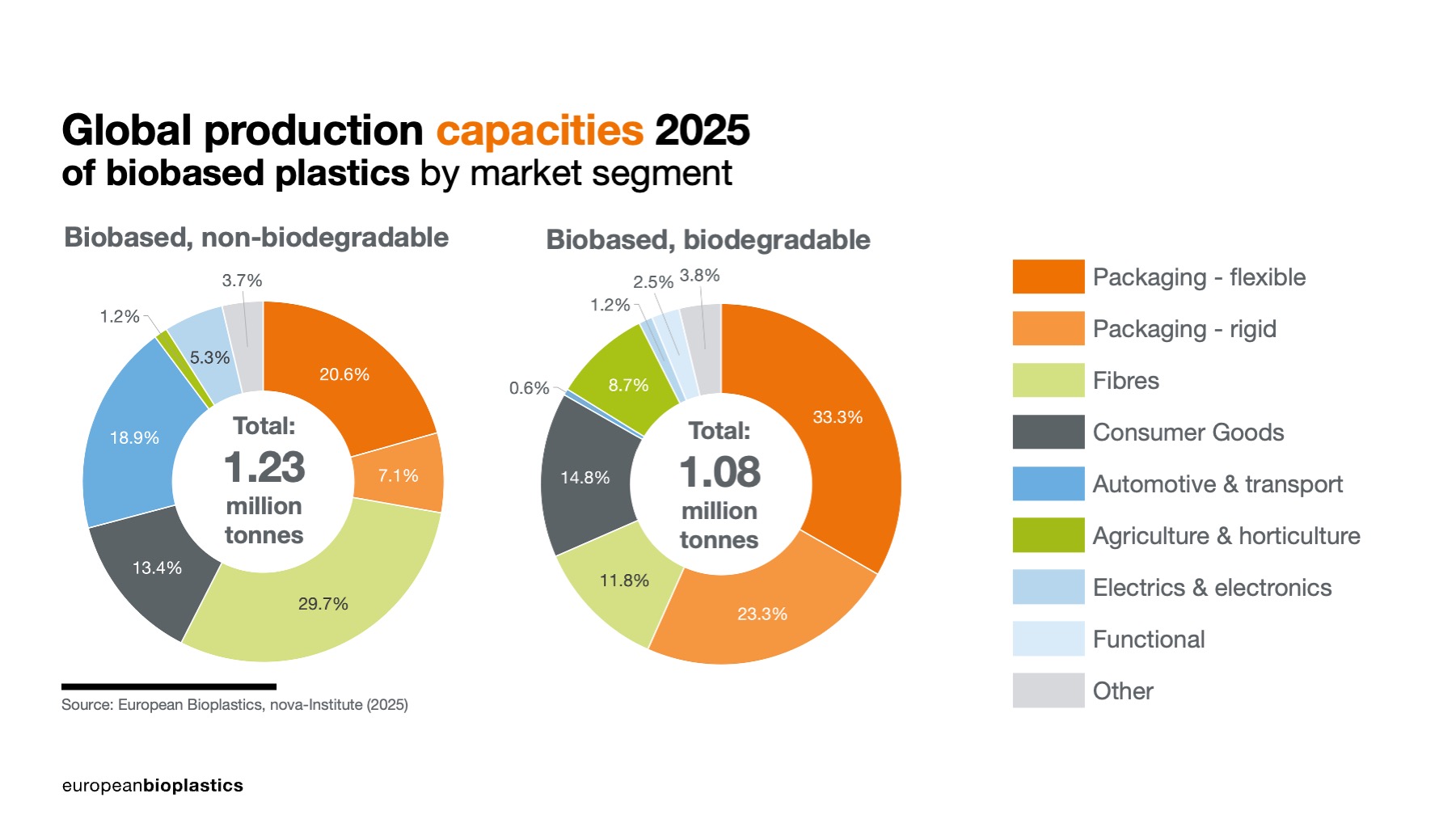
Bioplastics continue to diversify across sectors including packaging, textiles and fibres, consumer goods, automotive and agriculture. Packaging remains the largest market segment in 2025, accounting for 41.3% of global bioplastics production capacity (0.95 million tonnes), a slight decrease in share compared with 2024. The automotive and transport segment continues to expand and reaches 0.24 million tonnes, or 10.3% of applications.
The report compares installed production capacity with actual output. In 2025, the global bioplastics industry operated at an average utilisation rate of 72%, producing 1.67 million tonnes of material from a total capacity of 2.31 million tonnes. Utilisation levels differ by polymer type, ranging from 28% to 100%, depending on technology maturity and market conditions. In Europe, the utilisation rate averages 73%.
According to EUBP, the next phase of market development will depend on clear policy frameworks that support innovation and investment. Europe’s current bioeconomy agenda includes bioplastics as a component of industrial development, and regulatory coherence is identified as a factor in enabling further growth.