
A research project funded by Innosuisse at the Lucerne University of Applied Sciences and Arts is investigating the conditions under which workwear can nevertheless be integrated into textile cycles and where existing limits lie.
Workwear has structural advantages compared to other textiles. It is often standardised, comes from clearly defined supply chains and is managed centrally. In a pilot test, it was shown that used workwear can be mechanically recycled and spun into yarn again. The fabrics made from it contained a relevant proportion of recycled material, which is above the current industry level. However, further quality improvements must be achieved for widespread use, as workwear must meet high requirements for durability and durability.
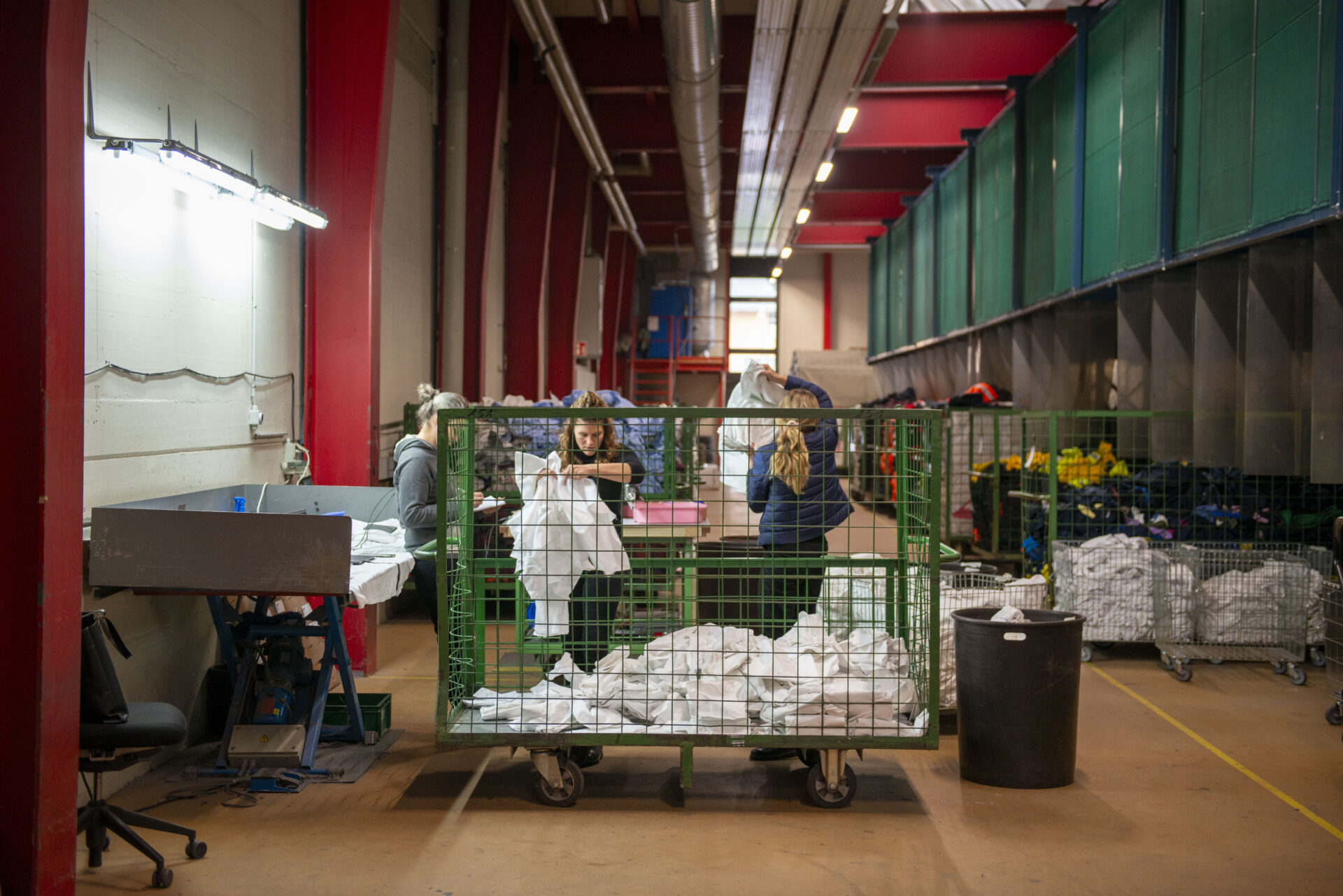
A central obstacle to textile cycles is the variety of fibre compositions and colours in used clothing collection as well as their inadequate declaration. Workwear offers more favourable conditions here, as large quantities of similar textiles are produced and their use is often documented. Through central washing processes and the use of RFID or chip systems, detailed information on material composition, service life and care cycles is available. This data creates transparency along the entire value chain and forms an essential basis for recyclable systems.
Against this background, the “Circular Workwear” project was initiated. Stakeholders from research, industry, textile collection, logistics and data management were involved. The aim was to develop circularly optimised workwear, test suitable collection and sorting processes and develop concepts for data exchange along the value chain. In addition, customer perspectives and mechanical requirements were included.
As a result, the participating companies have practical recommendations for action and an evaluation tool at their disposal that can be used to systematically analyse the recyclability of workwear. It also became clear that textile cycles can only be realised through close cooperation between the entire industry. Central starting points are improved networking, the consistent application of circular design principles and the continuous tracking of material and data flows. Economically, the competition between recycled and primary fibres remains a key challenge, as thermal recycling is currently often more cost-effective than material recycling.
The Lucerne University of Applied Sciences and Arts deals with the technical and economic requirements of the circular economy across departments. In addition to textiles, the focus is also on building materials, plastics and metals. In all areas, it is evident that functioning cycles require complex systems that can only be developed through the close integration of scientific research and practical implementation.