
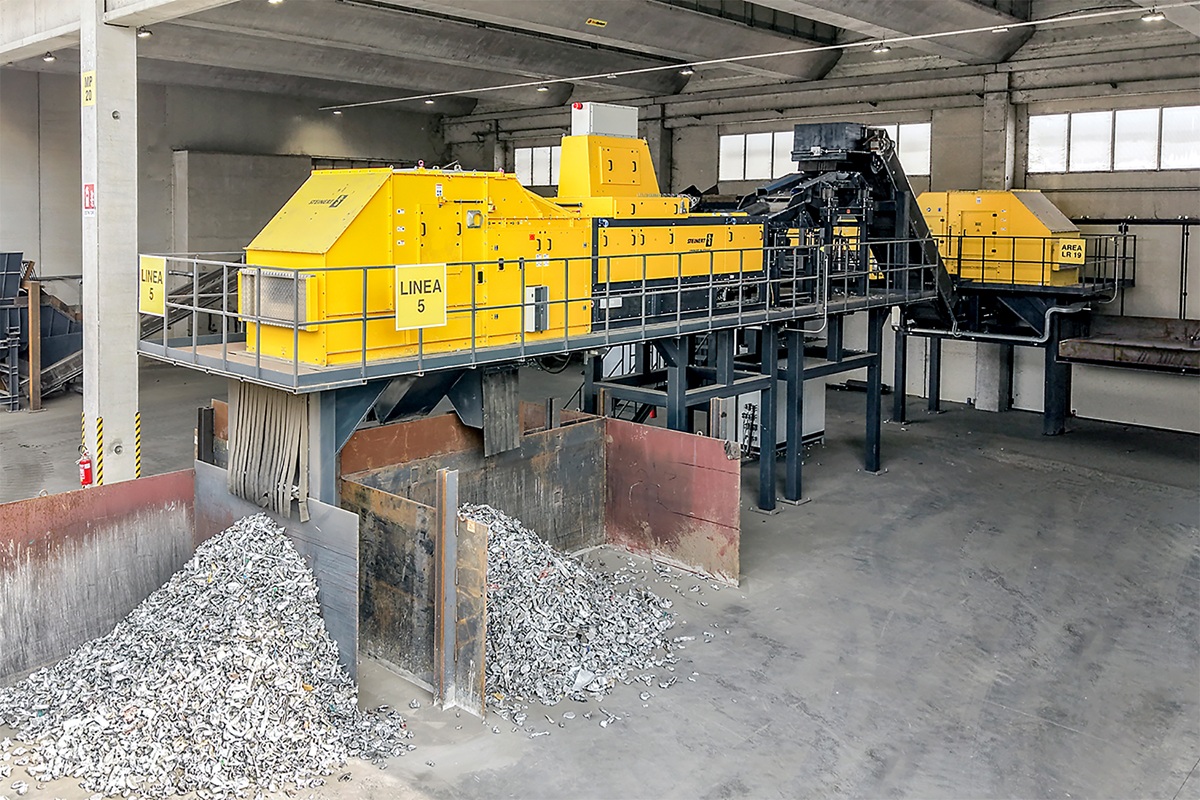
Over more than a decade, the company has expanded its processing chain in partnership with sorting technology supplier Steinert, adding a series of sensor-based systems for aluminium treatment and upgrading.
At Stemin, the performance of aluminium alloy sorting depends not only on sensor accuracy, but also on system durability. The company links advanced technology with lower energy consumption, higher hourly throughput and reduced downtime. Steinert states that, since 2020, it has supported this operating stability with a 20,000-hour warranty on its X-ray sources.
Five lines cover key separation stages
The Bergamo plant now operates five Steinert separation lines for key process steps, including eddy current separation, sensor-based light and heavy fraction separation, and aluminium alloy sorting with the Steinert Plasmax system based on LIBS technology. These systems convert mixed aluminium scrap into defined material streams for use in secondary smelting.
Before entering the Plasmax unit, mixed aluminium fractions containing plastics, light metals, heavy metals and different alloy types pass through several pre-treatment stages. The LIBS sensor then analyses each particle and sorts the material into homogeneous fractions according to alloy composition.
According to Steinert, the system can distinguish aluminium alloys from the 1xxx to 8xxx series at throughput rates of up to 11 tonnes per hour. It can also generate up to three fractions simultaneously, allowing recyclers to produce alloy-specific feedstock for direct supply to smelters.
Stemin reports purity levels of more than 99 per cent while maintaining stable throughput and plant availability. The company attributes part of this performance to the long-term technical cooperation between recycler and equipment supplier.
Upgrade targets smaller grain sizes
Steinert has also introduced a new upgrade for the Plasmax system aimed at processing finer grain sizes. The company offers industrial-scale trials at its Test Center in Cologne, enabling operators to assess performance with their own material before committing to an investment.
Remote support reduces downtime
For Stemin, service capability has been a central factor in its investment decisions. The company says all of its systems are connected for remote support, allowing many faults to be diagnosed and resolved within 30 to 40 minutes when an on-site technician is not immediately available. Stemin reports that even its most serious issue was resolved within two hours.
This level of service has helped shift the supplier relationship beyond conventional equipment delivery towards a more collaborative model focused on plant availability and operational continuity.
Test work supports investment decisions
Before new equipment is installed in Bergamo, Stemin uses the Steinert Test Center in Cologne to evaluate recovery potential and operating performance. For the company, the facility serves as a practical risk-management tool rather than a product showroom.
Stemin considers the ability to test its own material at industrial scale a key advantage. The company says this allows its technical team to assess what can be recovered not only in small sample quantities, but under conditions relevant to tonne-scale operation. On that basis, Stemin has repeatedly carried out test campaigns in Germany before making purchasing decisions.