
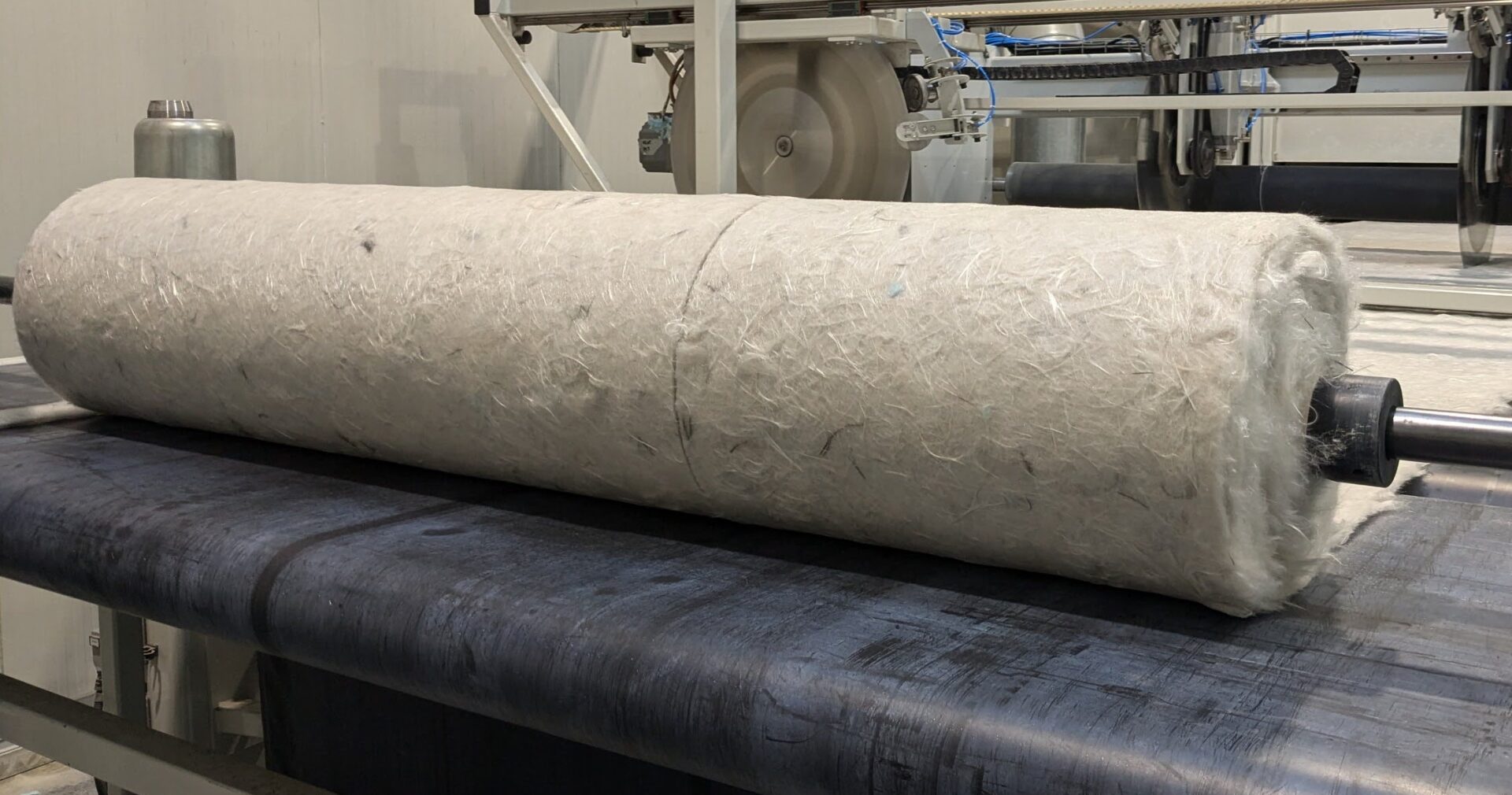
Within the study, CETMA (Italy) and Gjenkraft AS (Norway) collaborated with Cormatex (Italy) and ÉireComposites (Ireland). Glass fibres recovered using Gjenkraft’s thermal recycling process were converted into a nonwoven mat by Cormatex and then evaluated for use in composite manufacturing.
The nonwoven mat was produced using Cormatex’s airlay and thermobonding technology. In this process, fibres are distributed and bonded using a thermoplastic binder, rather than mechanically entangled through needlepunching. Thermobonding can be advantageous for thermally recycled fibres, which may become more brittle after exposure to high temperatures. According to the project partners, the process enables the production of mats with recycled fibre contents of up to 90–95% by weight.
CETMA assessed the compatibility of the recycled glass fibre mat with vacuum infusion, a manufacturing method commonly used for wind turbine blades and other composite parts. Tests indicated that composite laminates manufactured with the recycled mat showed mechanical properties close to those of laminates produced with comparable commercial virgin glass fibre mats.
To assess potential reintegration into wind energy applications, the recycled glass fibre mat was tested in a blade section produced by ÉireComposites. A 13 m blade design was selected, in which the composite skins are typically manufactured using virgin triaxial glass fibre reinforcement.
ÉireComposites manufactured a blade tip section measuring approximately 1.0 m by 1.5 m using vacuum infusion. The upper and lower shells were produced separately and bonded at the leading and trailing edges. One shell used triaxial glass fibre reinforcement in the inner and outer skins, while the other used the recycled glass fibre mat. This configuration enabled a direct comparison of virgin and recycled materials within the same component.
The prototype demonstrates the feasibility of incorporating recycled glass fibre into new wind turbine blade components without changing the manufacturing process. Further experimental work is currently underway at CETMA to validate mechanical performance in greater detail.
Beyond the thermal recycling route, the REFRESH project is also developing applications for secondary raw materials generated through mechanical recycling. Additional activities include research into the use of recycled fibres in 3D printed concrete structures, as well as a repurposing strategy based on precisely cut blade sections for new product applications. Sustainability assessment work within the project includes life cycle assessment and life cycle costing, alongside development of a traceability platform to track blade components and materials through the value chain.
REFRESH aims to support the scale-up of wind turbine blade recycling technologies and demonstrate pathways for reintroducing recycled composite materials into industrial applications, including new wind energy components.