
The system addresses a long-standing challenge in plastics recycling: black plastics are often excluded from mechanical recycling because established optical sorting technologies cannot reliably detect them. The demonstrator will be presented from 18 to 19 March 2026 at SOLIDS & RECYCLING-TECHNIK in Dortmund (Exhibition Centre Dortmund, Hall 4, Stand D47).
Transparent and coloured plastic packaging can generally be detected and separated by automated sorting systems. Black plastic components, however, are often not recognised by conventional optical technologies and are therefore frequently directed to thermal recovery. The approach developed by Fraunhofer IZFP uses thermography instead of short- or medium-wave hyperspectral imaging. According to the institute, the method enables the detection of thermal material properties that differ between polymer types. The system is designed to distinguish between black plastics that cannot be identified by near-infrared systems due to physical limitations. Initial work has focused on differentiating between polyamide (PA) and polypropylene (PP).
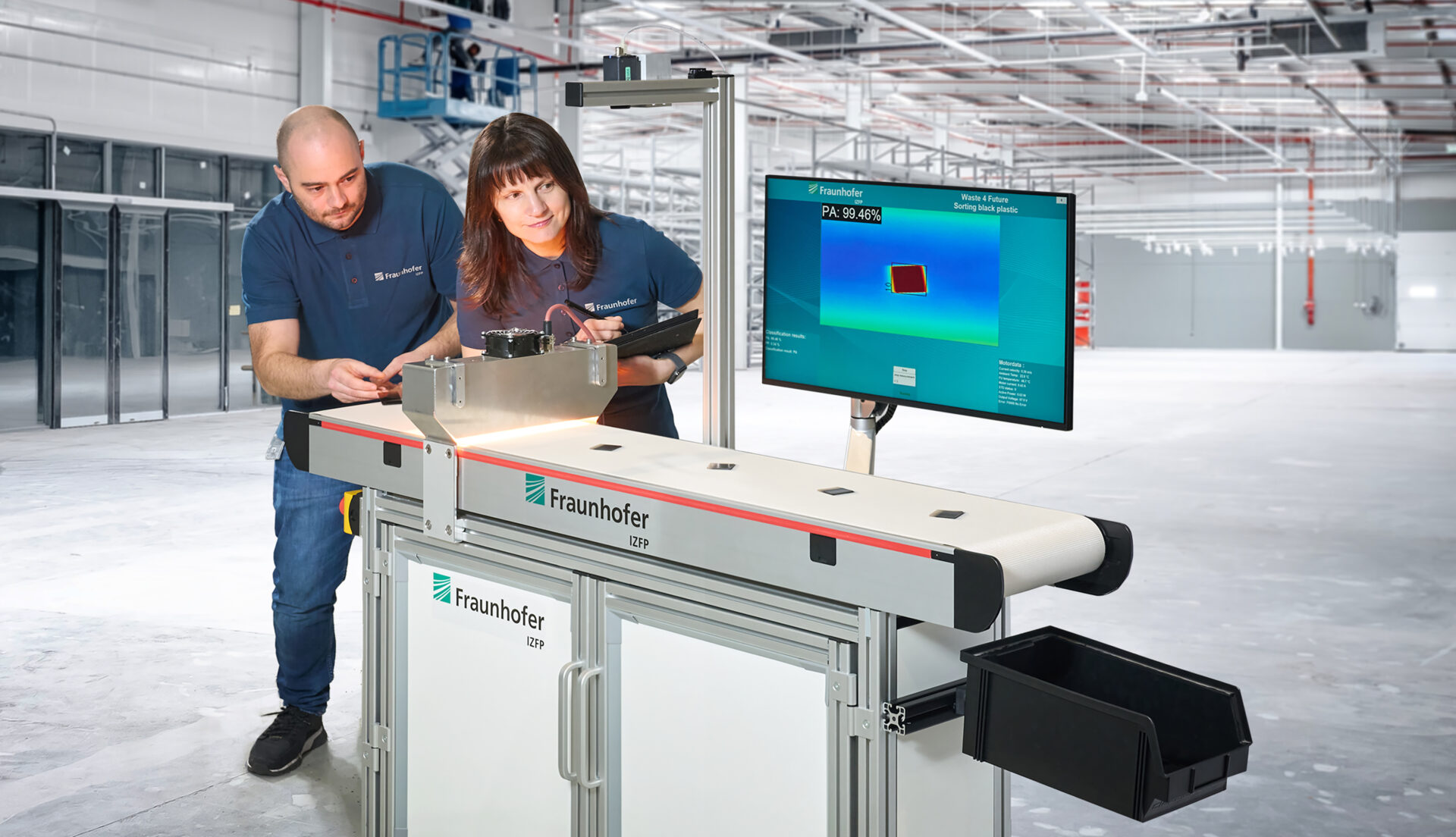
The demonstrator represents a complete sorting scenario under practical conditions. Black plastic samples are transported on a conveyor belt beneath an infrared radiant heater, where the material is briefly heated. A thermal imaging camera records the resulting temperature distribution. The thermal patterns are analysed in real time by a machine-learning model, which classifies the material. At the end of the conveyor belt, a sorting unit separates the plastics according to the identified polymer type.
Industrial sorting of black plastics could improve the recovery of secondary raw materials from waste streams containing these materials. This is relevant for sectors that use significant quantities of black plastics, including packaging, automotive components, electronic equipment and sporting goods.
The research team intends to extend the process to additional polymer types and increase the throughput of the system. Further work will examine alternative excitation methods and system optimisation with the aim of enabling industrial-scale applications.