
The facility has a capacity of 60,000 tonnes per year, equivalent to more than three billion trays, and is designed for tray-to-tray recycling at industrial scale. A decisive factor for this process is precise sorting.
For food-grade recycled PET, EU Regulation 2022/1616 requires that only packaging previously used for food contact may re-enter the food packaging cycle. A ready-meal tray therefore qualifies, whereas a PET blister pack for non-food applications does not. From a material perspective, both items consist of PET and cannot be distinguished by conventional near-infrared sorting systems based solely on polymer identification.
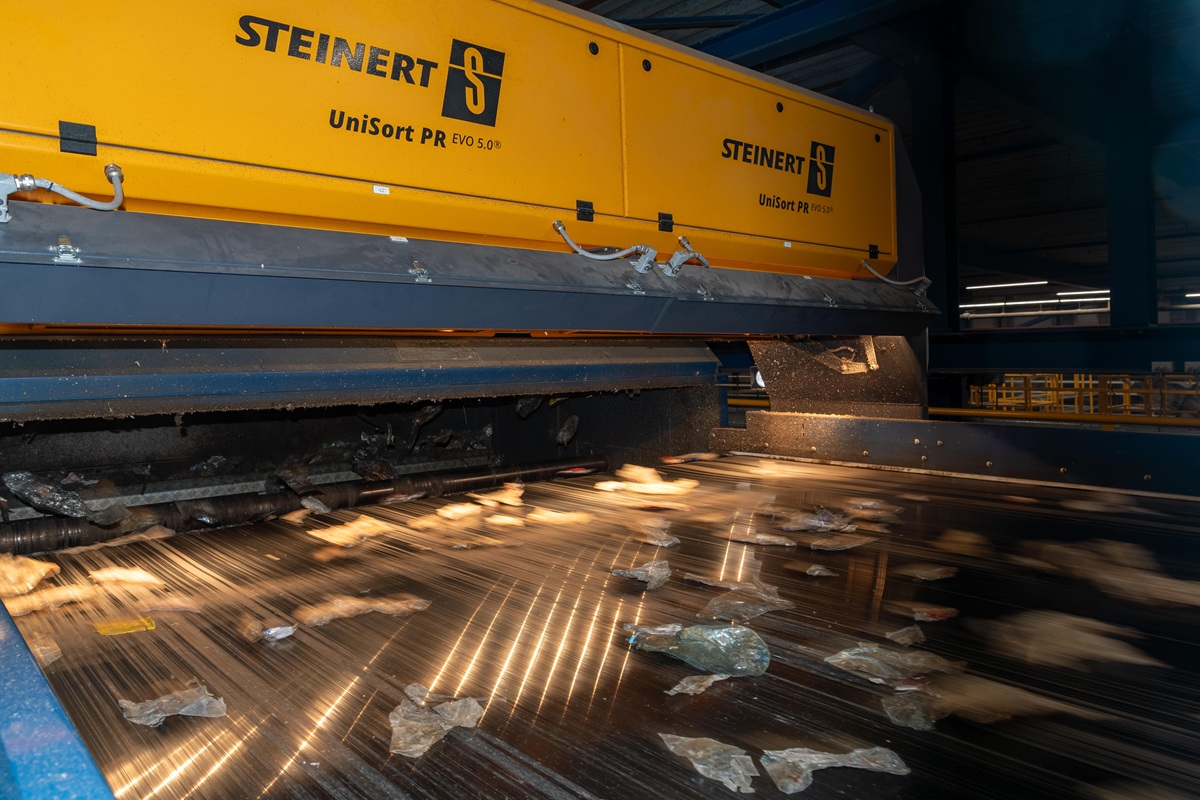
At the Cirrec plant, three Steinert UniSort PR EVO 5.0 sorting systems are used to analyse individual trays. The machines apply a sensor fusion approach in which a hyperspectral near-infrared camera records the chemical composition while a colour camera captures visual characteristics. Both sensors observe the same point on the material simultaneously, providing consistent data sets that support reliable artificial intelligence training and stable sorting performance.
The combined sensor data enable the use of Steinert Intelligent Object Identifier, an AI-based sorting application that has been trained to recognise food packaging. The system identifies characteristic features such as tray geometry, typical printing patterns and surface textures that are associated with food-contact packaging.
This sorting approach achieves purity levels exceeding 95 per cent, which is required for subsequent processing steps in food-grade recycling. After delivery, the baled material first passes through metal separation. Ferrous metals are removed by a Steinert UME overhead magnet, followed by the extraction of non-ferrous metals using a Steinert CanMaster eddy current separator. Optical sorting with the UniSort PR EVO 5.0 systems is then carried out before the material is ground, washed and processed into flakes and pellets.
The recycled material is supplied to Faerch Group production sites, where it is converted into new packaging with an average recycled content of around 70 per cent. According to a life-cycle assessment, the use of tray-based recycled PET results in approximately 57 per cent lower carbon dioxide emissions compared with virgin PET.
The Cirrec installation demonstrates that post-consumer PET trays from household waste streams can be recycled into food-grade material on an industrial scale, provided that sorting meets regulatory and technical requirements. The Intelligent Object Identifier software is designed as a flexible system and can be retrained for new sorting tasks if input streams change or new packaging formats are introduced, without the need for hardware modification. The concept implemented at the Duiven site shows how tray-to-tray recycling can be transferred from pilot applications to continuous industrial operation.