
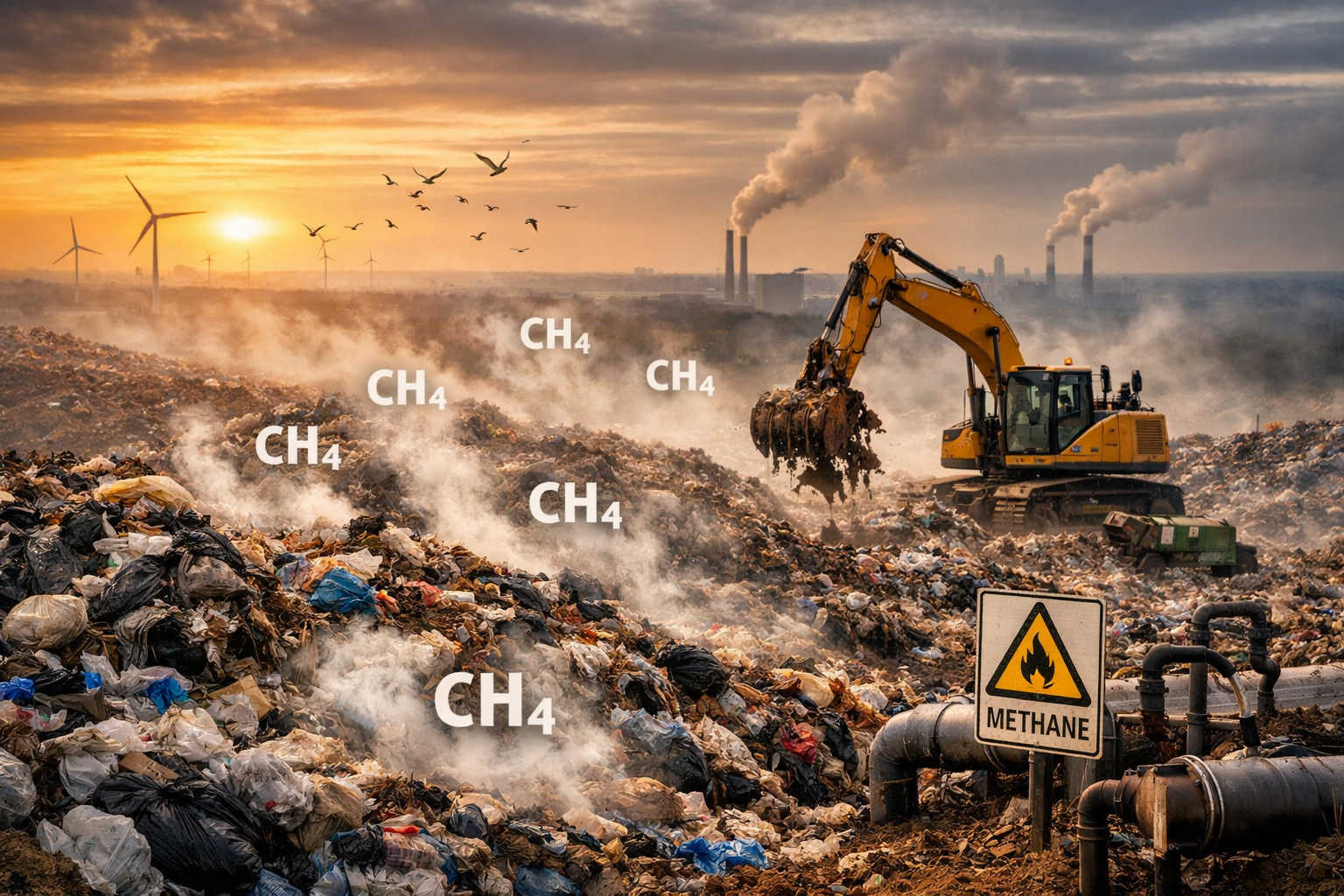
Methane is a short-lived climate pollutant with a high warming potential that affects both near-term and long-term climate dynamics. The study indicates that decisions taken today in waste management have measurable climate effects extending well beyond mid-century.
The analysis raises questions regarding the compatibility of Europe’s climate and circular-economy objectives with any weakening of landfill diversion measures.
The study, entitled “Methane emissions from Europe’s landfills – Scenarios and Data Challenges”, was conducted by Prognos Consulting and the ifeu Institute and initiated by Kanadevia Inova AG. It examines methane emissions from municipal solid waste deposited in landfills in the EU-27 and the United Kingdom between 2022 and 2050. In addition, it assesses the resulting climate impacts over several decades, demonstrating how landfill disposal creates long-term emission pathways.
The results show that landfill methane remains a relevant climate risk even when landfilling rates decline. Biodegradable waste continues to generate methane for decades after disposal, including long after landfill sites have been closed.
Under a status-quo scenario, approximately 1.9 billion tonnes of municipal waste landfilled between 2022 and 2050 would result in around 1.5 billion tonnes of carbon-dioxide-equivalent methane emissions, calculated using a 100-year global warming potential, by 2130. Around 37 per cent of these emissions would occur after 2050, despite the absence of additional waste inputs.
According to the study, full implementation of existing EU waste legislation, which limits the landfilling of municipal waste to 10 per cent by 2035, would reduce methane emissions by roughly half. Nevertheless, around 700 million tonnes of carbon-dioxide-equivalent emissions would still be generated over time. This underlines that the landfilling of biodegradable waste is associated with long-lasting methane emissions that are difficult to reconcile with the EU objective of climate neutrality by 2050.
When methane is assessed over a 20-year time horizon, reflecting its higher short-term warming effect, the climate impact increases significantly. Using a 20-year global warming potential, landfill methane emissions are nearly three times higher than under the 100-year metric. The study estimates cumulative emissions of around 4.5 billion tonnes of carbon-dioxide equivalents under the status-quo scenario and approximately 2.1 billion tonnes under full implementation of EU waste legislation. This illustrates methane’s relevance for near-term warming trajectories.
The study also identifies persistent data limitations in national greenhouse-gas inventories. Several countries rely on default values for waste composition and methane capture rates, while methodological differences reduce comparability. Findings from satellite-based research indicate that actual methane emissions from landfills may exceed reported figures.
Given these uncertainties, the study concludes that preventing biodegradable waste from entering landfills remains the most effective and reliable mitigation option. This approach is consistent with the waste hierarchy and circular-economy principles and is reflected in one of the analysed scenarios.
The findings have implications for ongoing policy discussions, including the potential inclusion of waste-to-energy treatment within emissions trading systems. If policy frameworks do not adequately account for the higher methane emissions associated with landfilling, there is a risk that residual waste streams could shift from controlled treatment towards landfill disposal. Such effects would counteract existing landfill-reduction strategies.
The analysis is also relevant for the United Kingdom, particularly in the context of discussions on a possible linkage between the UK and EU emissions trading systems. Policy signals that reduce the competitiveness of domestic residual waste treatment could increase the risk of waste exports and greater reliance on landfill disposal, with corresponding methane emissions. This would affect both national waste-management objectives and long-term climate targets.
Overall, the study highlights the importance of consistent waste and climate policies that prioritise landfill reduction, limit the landfilling of biodegradable waste and account for methane emissions over both short and long time horizons. Rapid methane mitigation is identified as a necessary element in maintaining progress towards European climate objectives.