
In its 60-year history, the trade fair has rarely been as closely linked to global economic developments as it is today. Supply chain disruptions and geopolitical tensions have intensified the discussion on raw material availability. In this context, the circular economy is regarded as an important instrument for reducing dependency on primary raw materials. At the same time, it maintains the competitiveness of European industry.
Political initiatives to strengthen recycling
Political initiatives in Europe are also focusing on the issue. In December 2025, the European Commission presented the RESourceEU action plan. The programme includes measures to improve resource efficiency as well as planned export restrictions for certain waste streams, including aluminium scrap and waste containing permanent magnets, with the aim of strengthening recycling capacities within the European Union. Additional measures include new labelling requirements and incentives to increase battery recycling.
Event programme addresses raw material security
Around six weeks before the start of the event, exhibitors are presenting technologies and concepts related to raw material recovery and recycling processes at IFAT Munich 2026. These include developments in lithium-ion battery recycling, new approaches to vehicle dismantling and digital technologies for more precise sorting of recyclable materials.
The trade fair programme also addresses these issues. Panel discussions on the Orange Stage in Hall A5 will examine strategies and frameworks for a circular economy. The discussions are organised by institutions including the BDE, GTAI, the German Federal Environmental Foundation (DBU) and the German Federal Ministry for the Environment.
Automotive recycling and closed material cycles
The automotive sector is considered one of the industries with high material demand. Within the European Union, efforts are underway to increase the recovery of materials from vehicles and maintain them in circulation wherever possible. At the same time, supply chain resilience and reduced dependence on imports remain central objectives.
These priorities are reflected in the planned European End-of-Life Vehicles Regulation (ELV-R), which is currently in the legislative process. The regulation provides for higher recycling quotas, increased use of recycled plastics and the introduction of a digital vehicle passport designed to facilitate dismantling and recycling.
The expansion of electromobility is also increasing the relevance of lithium-ion battery recycling. Batteries contain raw materials such as nickel, cobalt, lithium and graphite, which are considered strategically important. Although high recovery rates are technically achievable, the economic viability of recycling processes depends largely on raw material prices. At the same time, new industrial recycling capacities are emerging in Europe.
Several sessions on the Orange Stage at IFAT Munich 2026 will address these developments. Experts from the automotive and recycling sectors will discuss topics such as urban mining, closed material cycles and cooperation along the value chain.
Additional programme items focus on extended producer responsibility, including used tyre recycling and industrial processes for recovering critical raw materials from lithium-ion batteries. Organisers include BDE, the Resource Efficiency Center Bavaria (REZ), the Federal Association for Secondary Raw Materials and Disposal (bvse) and the Construction Machinery and Building Material Plants Association (VDMA).
Alongside expert discussions, the trade fair also offers practical demonstrations. In the outdoor area, the Federal Association of German Steel Recycling and Disposal Companies (BDSV) will present mechanical dismantling processes in a live demonstration under the title “Steel and metal recycling under the banner of Green Steel”.
Digital technologies and automation in recycling
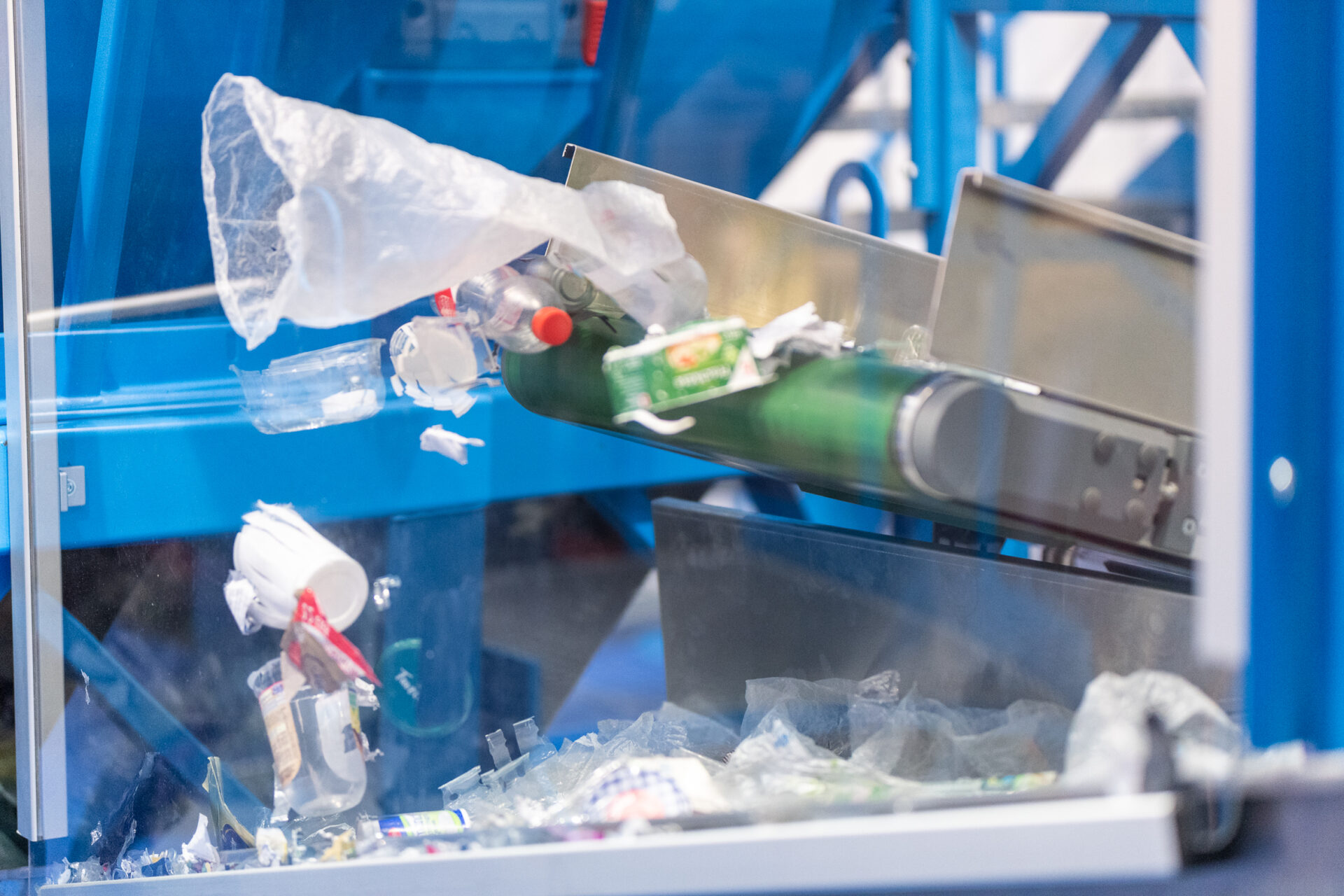
Artificial intelligence, robotics and digital technologies are increasingly influencing waste management and recycling processes. The sector expects improved sorting accuracy, more efficient operations and enhanced occupational safety. In addition, digital solutions may contribute to reducing emissions along the value chain.
Municipal waste management is also exploring potential applications. AI systems can help reduce incorrectly sorted waste fractions and support route planning for waste collection vehicles. A panel discussion organised by the German Association of Local Utilities (VKU) will address practical applications, implementation challenges and strategic perspectives for municipalities.
The VDMA will also present an initiative at IFAT Munich 2026 aimed at standardising data exchange between sensor-based sorting systems in order to improve interoperability and efficiency in recycling processes. Another event organised by the association will examine the role of digital product passports in enabling higher-quality recycling.
Opportunities and limits of AI and robotics
On the final day of the trade fair, the International Solid Waste Association (ISWA) will examine the use of artificial intelligence and robotics in waste management. The discussion will address both technological developments and operational challenges.
Examples include collaborative robots for dismantling electronic waste, AI-supported material recovery and digital systems for tracking material flows. At the same time, the practical implementation of these technologies depends on reliable data, standardised information systems and robust digital infrastructure.
Waste streams are often heterogeneous and contaminated, which can limit the performance of AI-based systems under real operating conditions. In addition, high investment costs may pose barriers, particularly for smaller recycling facilities and companies in low- and middle-income countries.
According to ISWA, a key challenge will therefore be to combine digital technologies with practical system solutions that can be implemented under diverse economic and operational conditions.