

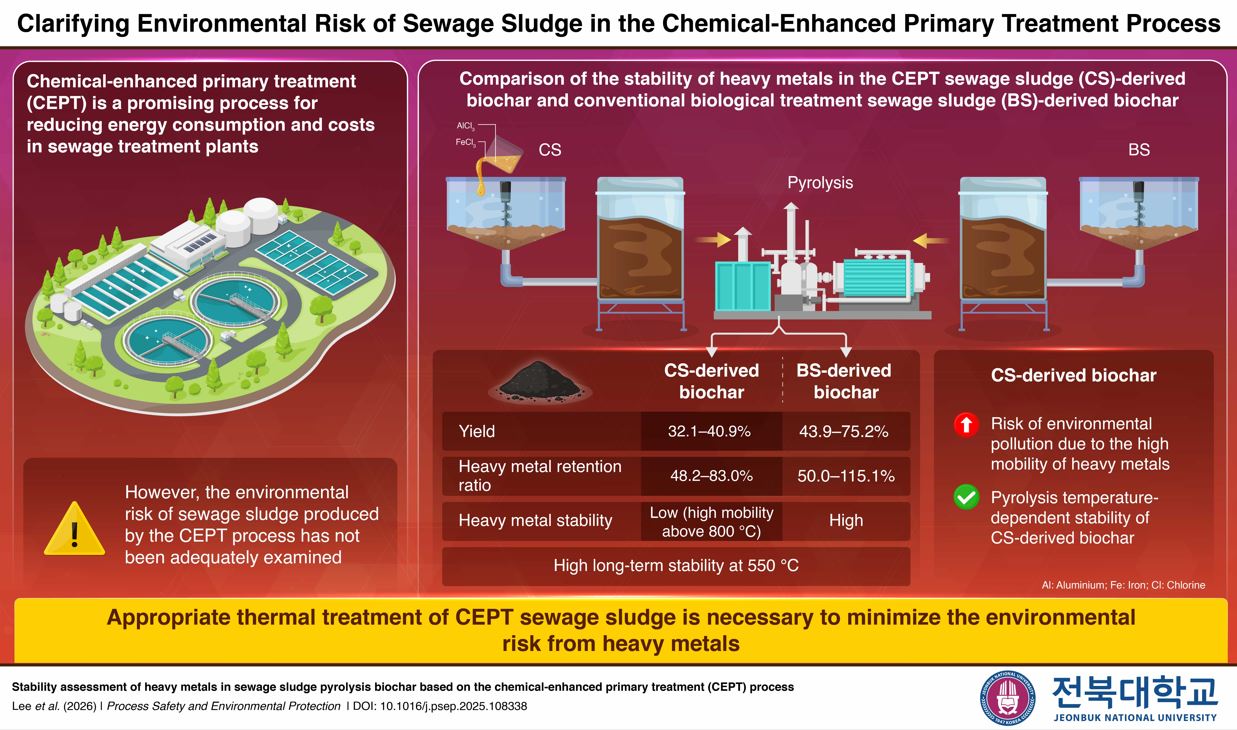
Jeonbuk National University researchers have investigated how pyrolysis temperature influences the environmental safety of sewage sludge from chemical-enhanced primary treatment (CEPT). The results indicate that controlling the pyrolysis temperature is a decisive factor for managing heavy metal stability and reducing environmental risks.
Increasing relevance of CEPT processes
CEPT is being adopted in sewage treatment plants to reduce energy consumption and operational requirements. Unlike biological treatment, the process relies on chemical coagulation and flocculation. While this approach can improve efficiency, it produces sludge with different properties, requiring further evaluation during downstream treatment.
Pyrolysis and biochar characteristics
Pyrolysis is widely used to reduce sludge volume and convert residues into biochar. However, CEPT-derived sewage sludge produces biochar with different characteristics compared to sludge from biological treatment. These differences affect the binding behaviour and mobility of heavy metals, which are relevant for environmental risk assessment.
Comparative analysis of sludge types
The research team compared CEPT sludge with biologically treated sludge using samples from treatment plants in Hong Kong. Both materials were subjected to pyrolysis at varying temperatures. The resulting biochars were analysed with regard to yield, heavy metal content and stability.
The results show that CEPT-derived biochar achieves lower yields than biochar from biological sludge. In addition, a smaller proportion of heavy metals remains bound in the material. This indicates a higher potential for secondary emissions during thermal treatment.
Temperature-dependent heavy metal stability
The study demonstrates that pyrolysis temperature sewage sludge treatment has a direct impact on heavy metal behaviour. At temperatures above 800 °C, heavy metal mobility increases significantly, raising the risk of leaching. In contrast, lower temperatures improve stabilisation.
At around 550 °C, both sludge types show comparatively stable heavy metal binding. Under these conditions, the resulting biochar may be suitable for applications such as soil amendment, provided regulatory requirements are met.
Implications for sludge management
The findings highlight the importance of process control in CEPT sludge treatment. Adjusting pyrolysis temperature can reduce environmental risks and improve material quality. As CEPT becomes more widely used, optimised thermal treatment strategies will be necessary to ensure safe handling of resulting residues.