
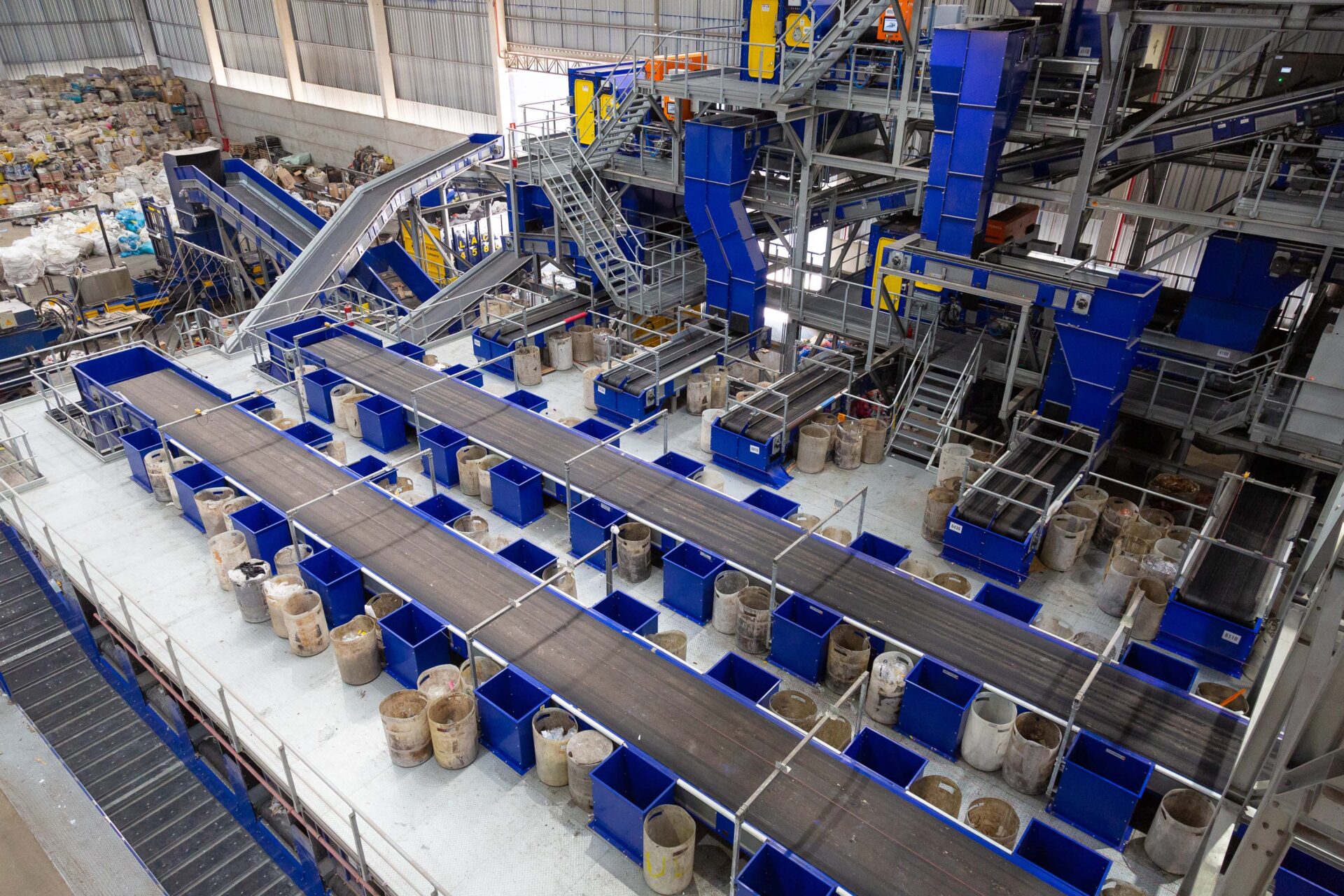
The flexible sorting plant processes up to 200 tonnes of dry mixed recyclables per day. It is designed to handle heterogeneous input streams while increasing material recovery rates and reducing residual waste.
Plant concept focuses on flexibility
The facility is configured to sort material into 21 fractions and to process varying input streams, including selective collection as well as commercial and office waste. This required a system design that combines stable performance with operational adaptability.
The process begins with a pre-sorting stage that separates material by bag colour, followed by a classification step using a ballistic separator to isolate cardboard. Pre-classified streams are stored and then fed into the main sorting line.
The main line includes dosing systems, bag openers and additional ballistic separators. Optical sorting systems, wind shifting, magnetic and eddy-current separation enable the recovery of plastics, films, paper grades, cartons, metals and refuse-derived fuel. This configuration allows adjustments to process parameters depending on input composition while maintaining consistent output quality.
Long-term collaboration supports project delivery
The project builds on previous operational experience with Stadler technology within the Multilixo Group. Earlier installations provided practical data on system performance under local conditions and informed the design of the Guarulhos facility.
The plant was developed through a joint engineering approach, including process testing and layout planning. Installation was completed within four months, followed by commissioning by a local service team. This enabled a structured ramp-up and operational handover.
Increased throughput and operational stability
Since commissioning, the flexible sorting plant has increased Flacipel’s monthly throughput from 4,800 tonnes to 8,000 tonnes. The higher capacity supports improved economies of scale and enhances the company’s market position.
The facility enables consistent material quality and traceability, which supports contractual agreements with customers seeking defined recycling outcomes. The operation also provides a stable processing environment with predictable performance.
An ongoing maintenance agreement includes regular inspections and preventive servicing to reduce downtime and support continuous operation.
Contribution to circular economy targets
The Guarulhos plant contributes to regional circular economy objectives by increasing sorting efficiency and directing output streams to defined recycling or recovery routes. The system minimises landfill disposal through comprehensive material separation.
Further upgrades are planned, including the expansion of the three-dimensional sorting line to increase the number of automatically sorted fractions. The flexible sorting plant is therefore positioned as an adaptable platform for future capacity and process developments.