
Currently, only a limited share of post-consumer textiles is processed into new fibres. Most materials are downcycled, incinerated or landfilled. Export markets for secondhand textiles are under pressure due to declining material quality, regulatory restrictions and reduced demand in destination countries. As a result, unsold volumes accumulate and are often disposed of without further recovery.
Limited supply for growing recycling capacity
New recycling capacities in Europe are expected to increase demand for post-consumer textile feedstock. However, the availability of suitable input materials remains constrained. Existing upstream systems for collection, sorting and pre-processing do not yet provide the required volumes at consistent quality and competitive cost.
Post-consumer textiles are heterogeneous and require complex processing. Recyclers operate with defined material specifications that vary by technology. At the same time, sorting operators face high processing costs and limited market outlets for certain fractions. This creates a structural gap between supply and demand, with post-industrial waste continuing to dominate recycling inputs due to its higher consistency and lower processing requirements.
Regulatory pressure drives market development
The integration of post-consumer textile feedstock into recycling systems is expected to accelerate. Demand for recycled fibres is increasing, supported by regulatory developments such as Extended Producer Responsibility in the European Union. These frameworks require producers to take responsibility for end-of-life management, increasing the need for scalable recycling solutions.
Value chain collaboration in Project FAE
Project FAE brings together stakeholders across the textile value chain, including brands, sorting operators and recycling companies. Participating brands include adidas as lead partner, as well as BESTSELLER and INDITEX. The project is supported by ReHubs as strategic partner and Rematters for operational implementation.
Advisory partners include sorting companies such as Boer Group, Circle-8 Textile Ecosystems, Erdotex, Formació i Treball, Humana People to People, Kringwinkel Antwerpen, New Retex, Nouvelles Fibres Textiles, Plaxtil-Essaimons, Sympany, Texaid and Texlimca. Recycling partners cover mechanical, thermomechanical and chemical processes, including Circ, Circulose, CuRe Technology, eeden, Infinited Fiber Company, Kipas, Matterr, Meltem Kimya, Recover, Reju, OnceMore by Södra and Worn Again. Additional support is provided by organisations such as InvestNL, Landbell Group, Refashion, Reverse Resources, TEXroad, Wargon Innovation, WRAP, ZDHC and Global Fashion Agenda.
Technical and infrastructure development
The project follows two parallel approaches. The first focuses on improving feedstock preparation through advanced pre-processing technologies, including fibre blend separation, elastane removal and contaminant extraction. The aim is to assess both technical performance and economic feasibility.
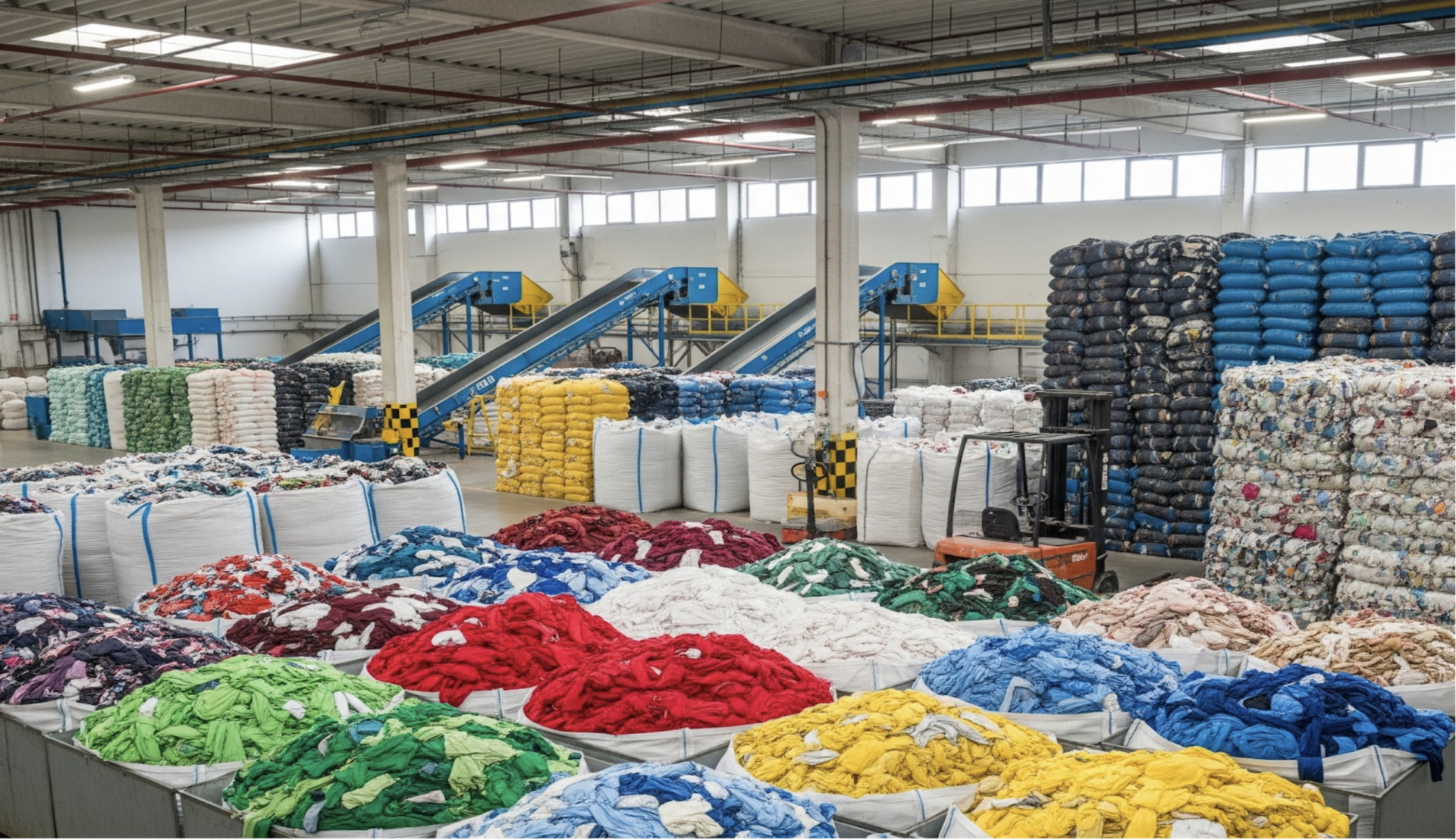
The second approach addresses infrastructure development. Project FAE will define a framework for regional hubs dedicated to large-scale sorting and pre-processing of post-consumer textile feedstock. These hubs are intended to aggregate material flows, apply automated sorting and produce input streams tailored to recycling technologies.
By increasing scale and automation, the hub model seeks to reduce processing costs, improve material quality and support the economic viability of textile recycling. The project is designed to deliver a framework for implementation, contributing to the development of a functional post-consumer textile value chain in Europe.