
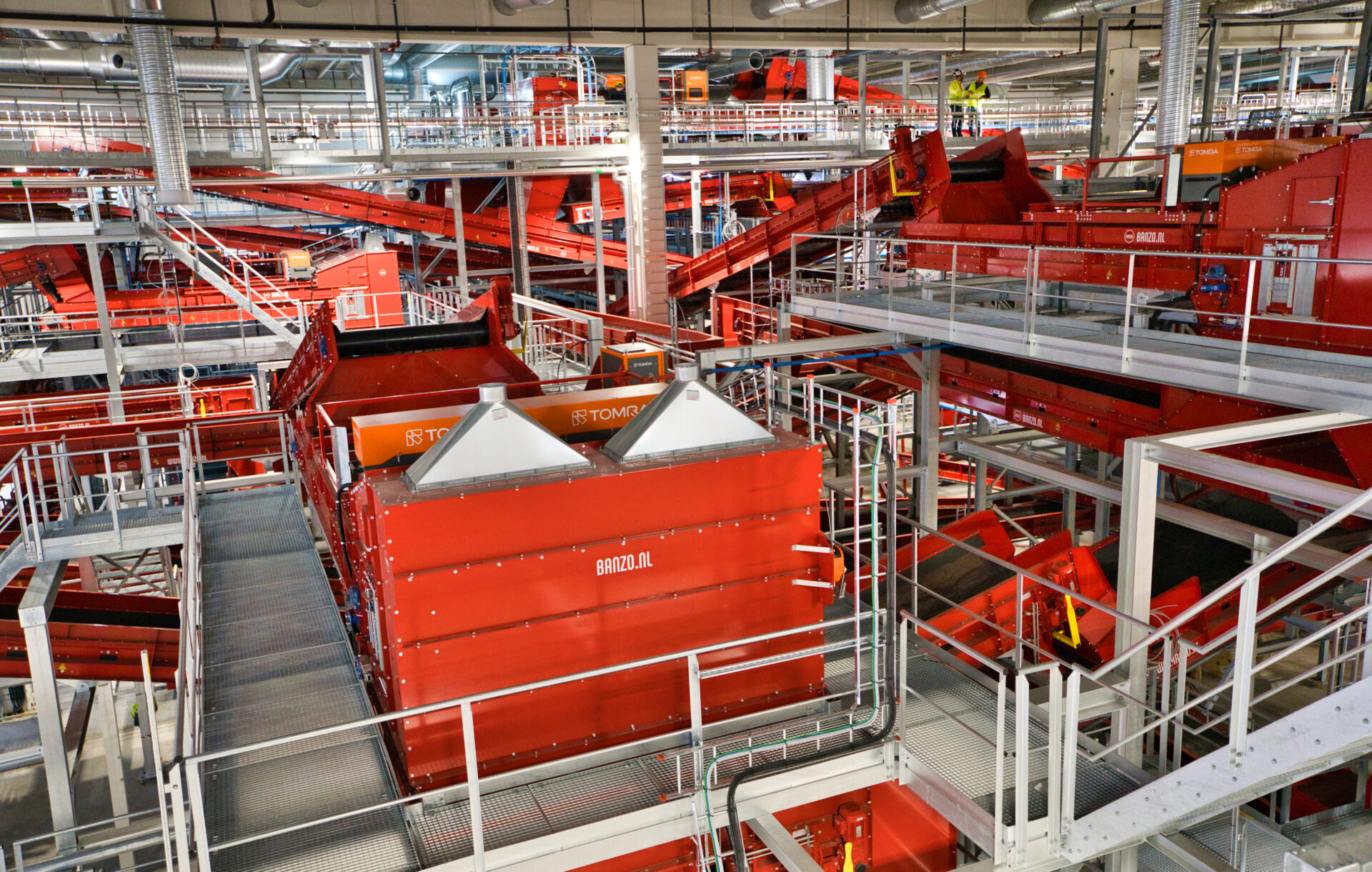
The plant was realised by the Dutch company BANZO as system integrator and completed within eleven months. Screening technology supplied by the German manufacturer Spaleck is used to classify material flows and support downstream sorting processes.
Capacity and process design
The MSW processing plant is designed for an annual capacity of around 200,000 tonnes and processes up to 40 tonnes per hour. The fully automated system separates five fractions: plastics, paper and cardboard, ferrous metals, non-ferrous metals and organic components.
According to the operator, recovery rates reach 92.8 per cent for mixed plastics, 93.1 per cent for paper, 94.1 per cent for ferrous metals and 88.0 per cent for non-ferrous metals. Residual waste that cannot be recycled is transported via a 250-metre conveyor bridge directly to two neighbouring waste-to-energy plants.
Screening technology for material classification
Four screening machines from Spaleck are integrated into the process. A recycling waste screen upstream of the shredder separates coarse material, reducing energy consumption and wear in the shredding stage. Two further screening units prepare the material stream for sorting by ensuring consistent particle size distribution.
A flip-flow screening machine removes moist fine particles, which reduces the load on subsequent sorting equipment and contributes to stable plant operation.
Integrated sorting system
In addition to screening technology, the MSW processing plant includes a pre-shredder, 14 near-infrared sorting units, three magnetic separators, three eddy current separators and an X-ray sorter.
BANZO was responsible for overall coordination and system integration. The plant is based on a central control and interface concept that integrates mechanical components, electrical engineering and digital systems.