

The UPCYCLE project, funded by Horizon Europe under the European Health and Digital Executive Agency (HADEA), officially kicked off with a two-day meeting in Gent, Belgium.
Packaging
-
-
Today Omra, Norway’s new national facility for sorting all types of plastic packaging waste, has opened.
-
In 2023, 79.7 million tonnes of packaging waste were generated in the EU, or 177.8 kg per inhabitant. While this marks a reduction of 8.7 kg per capita compared with 2022, the figure remains 21.2 kg higher than in 2013.
-
A new study from Iowa State University compiles global lists of restricted substances in food packaging. The research, supported by IAFNS, highlights chemicals of concern and offers a resource for regulators, manufacturers and recyclers.
-
Tray-to-tray recycling is becoming a recognized approach for advancing circularity in plastic packaging – especially for food-grade applications. Valerio Sama, Business Development Manager – Packaging at Tomra Recycling, examines the latest developments in tray-to-tray recycling, detailing the challenges, technologies and market trends shaping its growth across the industry.
-
The use of bioplastics in packaging applications is emerging as a more sustainable alternative to conventional non-biodegradable plastics derived from fossil sources. However, further research is needed to ensure that biodegradable and/or compostable plastics can meet the necessary requirements to preserve and extend the shelf life of packaged products.
-
Legal requirements, above all the EU packaging and packaging waste directive (PPWR), and the sustainability goals of global brands are increasing the demand for post-consumer recycled pellets to be used in sensitive applications such as food or cosmetics packaging, as well as in secondary packaging. These specifications increase the demands on the production capacity and process stability of recycling plants in order to guarantee high output volumes with a consistently high quality.
-
A joint initiative of EuPC, EXPRA, EPRO, NMWE, PETCORE Europe, and UNESDA has led to the publication of a comprehensive guidance document to support waste management operators and sorters in setting up third-party certification of quality assurance systems for recycled materials and articles.
-
New research from Aquapak shows that the majority (70%) of British consumers admit they are confused by what packaging can and can’t be recycled.
-
Infinitum AS is the leading foundation that manages Norway’s deposit-return scheme since 1999. Norwegians are world champions when it comes to returning their empty bottles and cans. In Norway, all producers and importers of beverages, in either cans or non-refillable bottles (PET), can register their products in the deposit system.
-
Steel for Packaging Europe has confirmed the highest ever EU recycling rate for steel packaging, bringing the steel packaging sector even closer to fully closing the material loop.
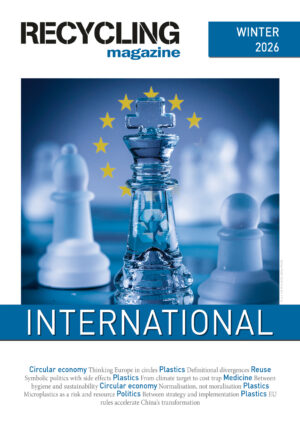
Next events
RECYCLING magazine provides independent, deeply investigated information about all aspects of secondary raw materials. The magazine has a long track record, it has a history of more than 70 years. more
RECYCLING magazine is a member of






© DETAIL Architecture GmbH
