

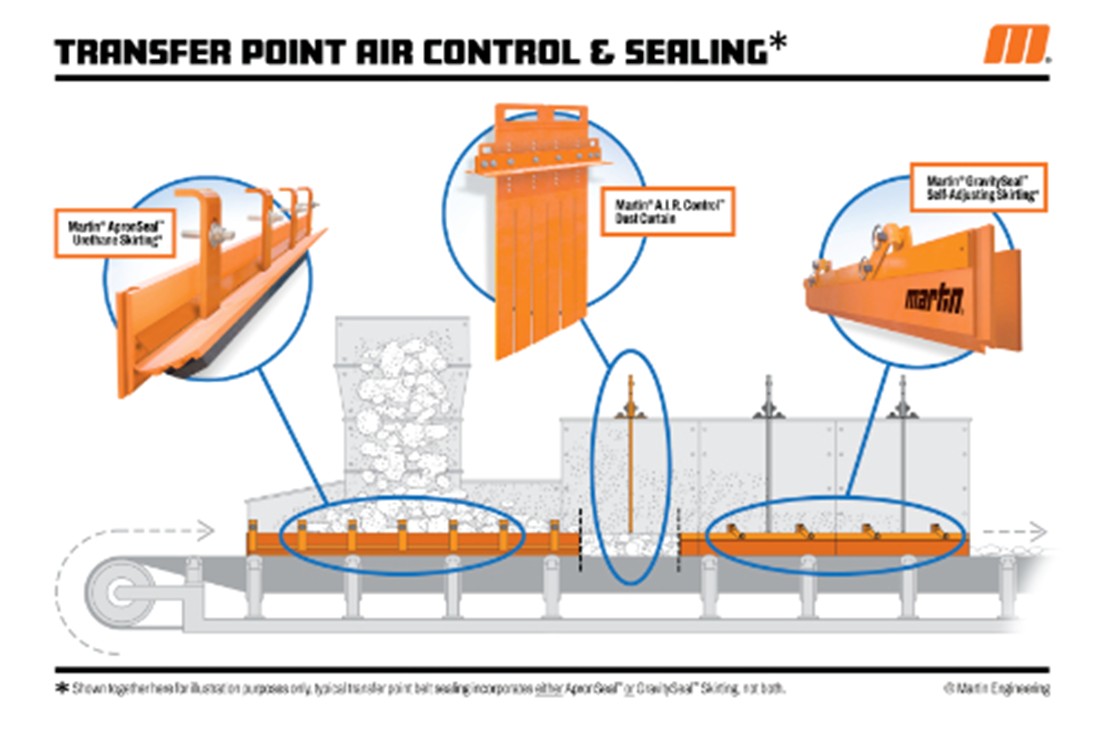
Urethane skirting for effective sealing
The ApronSeal urethane skirting is installed along the skirtboard and consists of a primary sealing strip shaped to the belt trough angle. An optional secondary outer flap compensates for variations in belt profile and supports additional dust containment.
The system requires approximately 50 mm of free belt area and can be adapted to available space. It is supplied in modular lengths with T-slot connections for extended chutes. External maintenance access is intended to improve safety conditions during servicing.
The material is a 90-durometer urethane designed for belt speeds up to 4.5 m/s. It is resistant to chemicals and abrasion, with a high-temperature variant available. Reduced friction contributes to extended service life.
The GravitySeal system uses torsion arms to allow the urethane skirting to follow vertical belt movement. This maintains a consistent seal and reduces the need for manual adjustment as components wear.
The system is suitable for conveyor speeds up to 6.5 m/s and requires minimal free edge space. Continuous urethane strips are available in lengths up to 91 m, with a wear allowance of approximately 51 mm. Replacement is carried out via a pin-based fastening system designed for quick installation.
Dust curtains for enclosed transfer points
The A.I.R. Control dust curtain is designed for enclosed transfer points. It consists of modular urethane curtain cartridges that can be adjusted or replaced from outside the enclosure. This reduces the need for confined-space entry during maintenance.
Each unit contains individual urethane flaps that can be cut to match the material flow angle. Installed close to the conveyed material, the curtains create recirculation zones that support dust particle agglomeration and settling. This contributes to reduced airborne dust compared to conventional curtain designs.
Passive conveyor dust control and compliance
The combination of urethane skirting and dust curtains forms a passive conveyor dust control system. Installed at transfer points, the systems aim to reduce emissions and spillage while supporting compliance with air quality and occupational safety requirements.
By avoiding energy-intensive dust extraction systems, the solutions are intended to lower maintenance demands and operating costs. The use of urethane as a material supports durability under typical bulk handling conditions.