
The report, published on 27 April 2026, analyses the role of bio-based feedstocks within the framework of the EU Packaging and Packaging Waste Regulation (PPWR). The study examines technological readiness, greenhouse gas reduction potential and policy options for integrating bio-based plastics into future EU sustainability strategies.
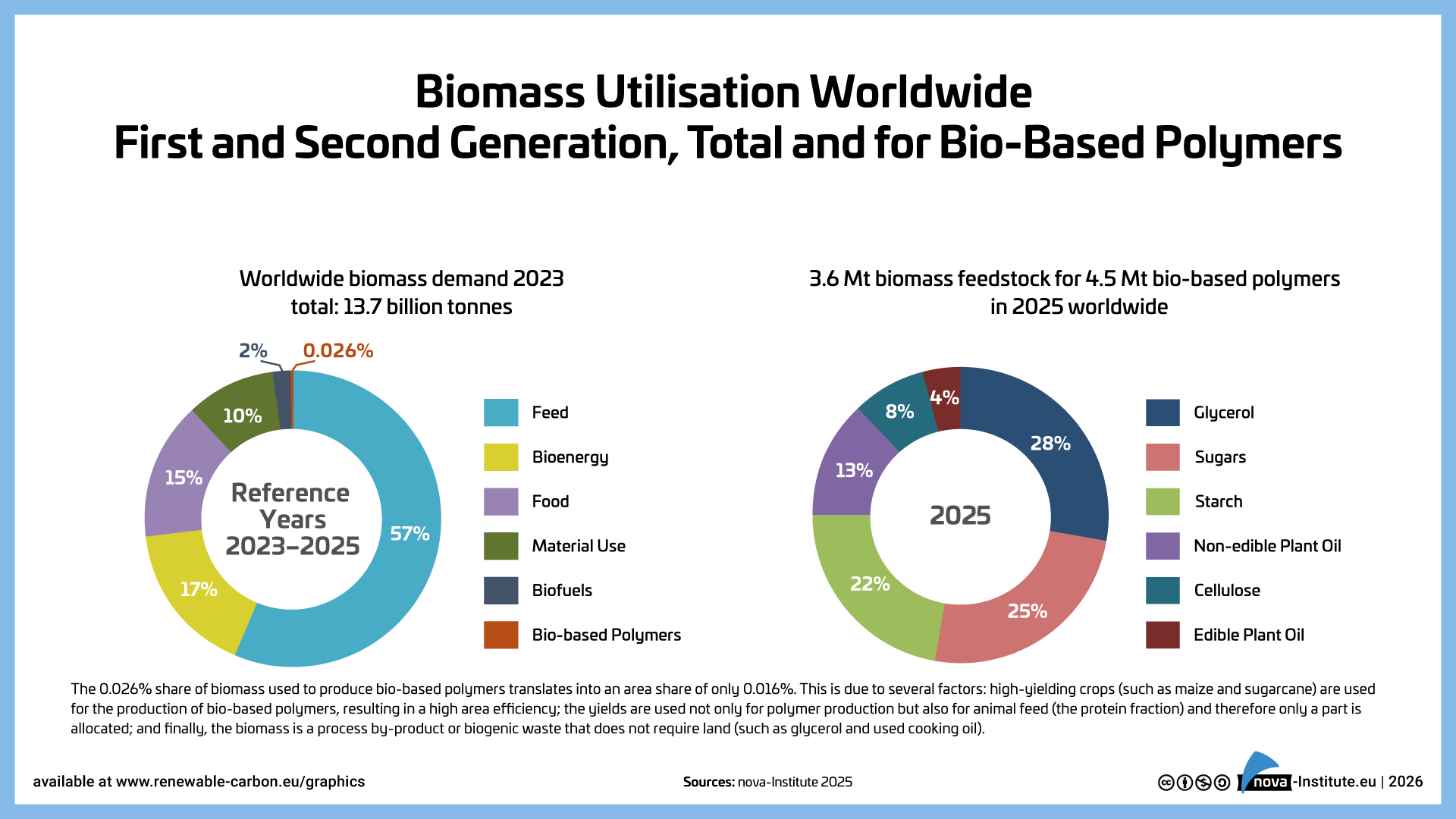
According to the analysis, plastics are still more than 99% fossil-based worldwide, while bio-based polymers account for around one percent of the market. Nevertheless, 17 bio-based polymers are already commercially available and suitable for packaging applications. The study states that these materials are technologically mature and can contribute to reducing greenhouse gas emissions compared with fossil-based alternatives.
Complementary role to recycling
The PPWR already establishes binding recycled-content targets for plastic packaging. However, the regulation does not yet clearly define how bio-based carbon should contribute to the transition away from fossil resources.
The report argues that recycling alone will not provide enough non-fossil carbon feedstock to meet long-term climate targets and future material demand. Bio-based feedstocks therefore play a complementary role by introducing additional renewable carbon into the system.
The authors stress that recycled and bio-based carbon should not be treated as competing approaches. Recycling keeps existing carbon in circulation, while bio-based feedstocks add renewable carbon to the material cycle. A balanced policy framework supporting both approaches is therefore considered essential for a climate-neutral and circular plastics economy.
Michael Carus, founder and senior advisor at nova-Institute, said that the transition to climate-neutral packaging would require a combination of bio-based carbon, carbon dioxide utilisation and recycling technologies. He added that both higher bio-based content and increased recycling rates would be necessary to replace fossil carbon in packaging applications.
Scaling remains a challenge
Despite their technical maturity, bio-based plastics still face barriers to large-scale market adoption. The study identifies higher production costs, limited processing infrastructure and uneven policy support compared with biofuels as key obstacles.
To accelerate deployment, the report recommends introducing binding targets for bio-based content, harmonised sustainability criteria and further investment in recycling and processing infrastructure. The study also proposes aligning sustainability rules for bio-based plastics with the Renewable Energy Directive.
According to the report, these measures would support the availability and scalability of renewable carbon feedstocks and strengthen the role of bio-based plastics within a circular carbon economy.
Support for renewable carbon transition
nova-Institute stated that the study reflects its long-standing focus on renewable carbon and defossilisation strategies for the chemicals and materials industries. The organisation supports companies, policymakers and investors through market studies, strategic consulting and sustainability analysis related to renewable carbon technologies and regulation.
Dr Lars Börger, chief executive officer of nova-Institute, said independent scientific analysis would remain important for guiding complex industrial transformation processes and developing evidence-based European policy.