
At recycling facilities, these batteries pass through several sorting stages before ending up in the ferrous metal fraction alongside other materials. Their small size, irregular shape, and mixed composition make reliable separation difficult. As a result, batteries contaminate metal streams, reduce material value, and increase fire risks during downstream processing.
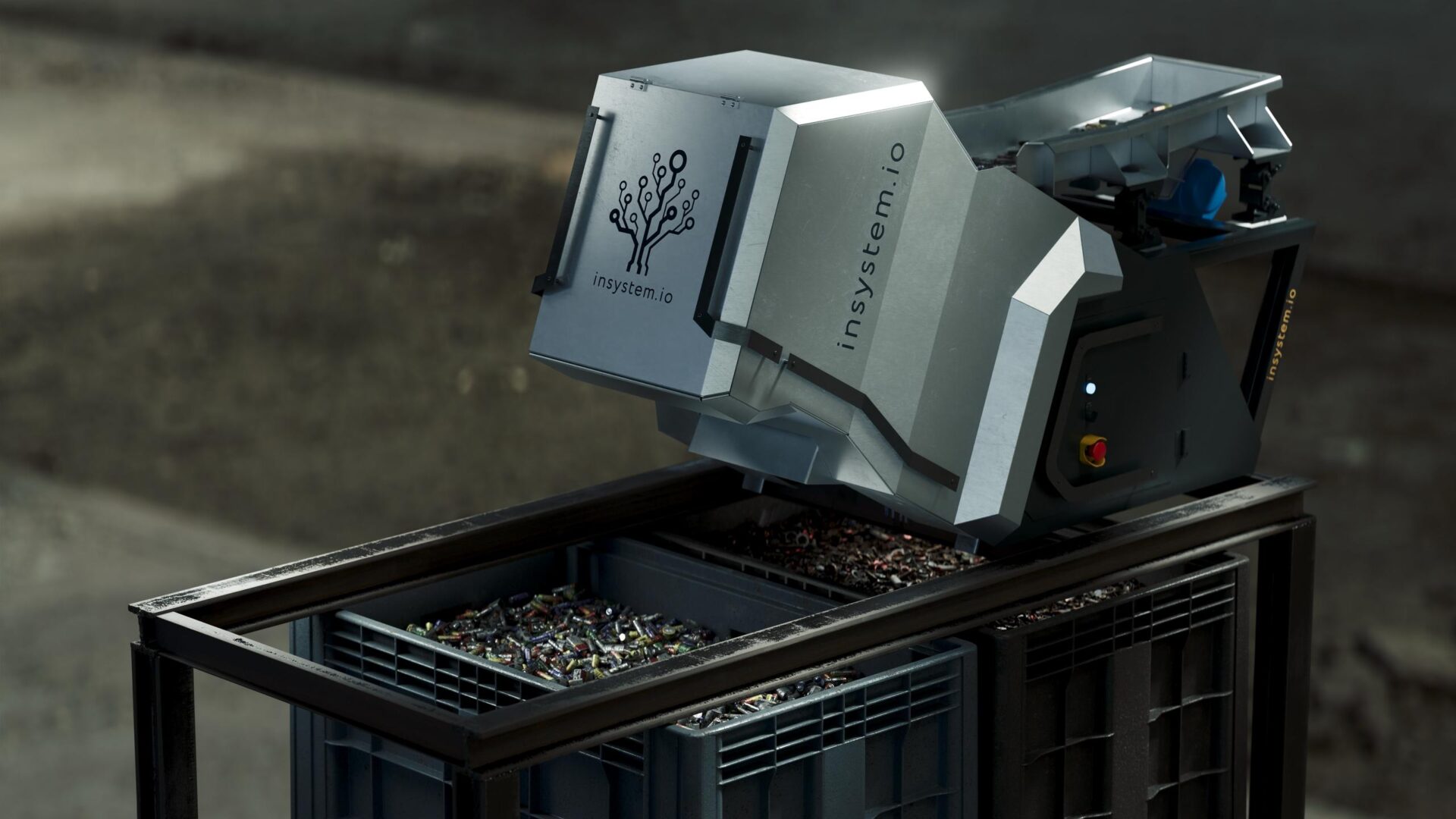
Dutch startup inSystem.io has developed a new AI-based sorting unit designed to address this issue. The company states that its Gravity Sorter achieves more than 96% purity when separating battery-containing fractions during facility trials.
Sorting Challenges in Fine Material Fractions
The difficulty is particularly significant in particle sizes between 5 and 70 millimetres. Conventional sorting systems often lose efficiency in this range because materials are dense, unevenly shaped, and difficult to process aerodynamically.
In many facilities, recoverable materials from these streams are still sent to landfill or refuse-derived fuel production. For municipal solid waste battery fractions, manual sorting has largely remained the only available solution. However, hand-picking creates additional labour costs, safety concerns, and inconsistent sorting quality.
Batteries that remain undetected can contaminate ferrous scrap output or contribute to fires in recycling facilities.
Free-Fall Sorting System
According to the company, the Gravity Sorter separates mixed batteries in a single pass and produces a concentrated battery fraction. The system operates at throughput rates of up to six tonnes per hour.
The unit is designed for integration into existing sorting lines without major modifications. Operators manage the system through the company’s cloud platform, where they can configure material fractions, adjust ejection parameters, monitor operations in real time, and retrain AI models using newly labelled image data.
AI-Based Object Tracking
The Gravity Sorter uses continuous trajectory tracking during free fall. AI-supported cameras operating at up to 400 frames per second monitor each object across multiple frames and calculate its trajectory in real time.
High-pressure air nozzles activate at calculated ejection points within 0.25 milliseconds. According to the company, this approach enables the system to process heavy and irregularly shaped objects that are difficult to separate with conventional belt-based sorting technologies.
The AI system analyses object characteristics including text, shape, and colour. The platform can also be upgraded with near-infrared, short-wave infrared, and long-wave infrared sensors for additional material identification. These upgrades allow detection of polymers such as polyethylene terephthalate, high-density polyethylene, and polypropylene.
Range of Applications
The system processes mixed batteries including lithium-ion, alkaline, nickel-metal hydride, nickel-cadmium, and button cells. Additional applications include electronic waste fragments, plastic flakes, incinerator bottom ash, non-ferrous metal scrap, and construction and demolition aggregate fines.
The sorter is available both for retrofitting into existing facilities and for integration into new recycling lines.