

The European Commission has published details of its mass-balance approach under the Single Use Plastics Directive (SUPD) implementing act voted through on 6 February.
Packaging
-
-
The recycling rate for aluminium beverage cans in the European Union, the United Kingdom, Switzerland, Norway and Iceland reached 76.3% in 2023, according to the latest data published by Metal Packaging Europe and European Aluminium.
-
The U.S. Plastics Pact has published a framework outlining measures to advance the circularity of film and flexible plastic packaging in the United States. The document, titled “Journey to Film & Flex Circularity: A Framework of Necessary Design, Collection, and End Market Levers,” identifies system-level actions across packaging design, collection systems and end market development.
-
Two years after its launch on 1 February 2024, Ireland’s Deposit Return Scheme (DRS) demonstrates the role of digital infrastructure in operating a national circular economy system at scale. Since becoming operational, the scheme has processed close to 2.5 billion returned beverage containers, supported by an integrated IT platform managing data, transactions and reporting across the value chain.
-
The UK’s Extended Producer Responsibility scheme for packaging, introduced in October 2025, is designed to make producers financially and operationally responsible for the packaging they place on the market and its end-of-life management.
-
Stadler has completed the modernization of the BZB light packaging sorting plant in Amorebieta-Etxano, Bizkaia, Spain, upgrading the facility originally commissioned in 2002.
-
Steel for Packaging Europe has announced a programme of activities to mark its 40th anniversary, centred on the publication of a new recycling status report.
-
Amcor is supporting a three-year plastic recycling project led by the Danish Technological Institute. The co-funded innovation partnership, Circular Recycling Innovation for Sustainable Packaging (CRISP), aims to enable full-scale circular recycling of rigid polyethylene (PE) and polypropylene (PP) food packaging from household waste streams in Denmark.
-
Austria’s deposit return scheme (DRS) is approaching the end of its first year with stable operational performance and high return volumes. By the end of November 2025, more than 1.2 billion PET bottles and aluminium cans had been collected.
-
Incorporating recycled plastic into food contact applications is necessary to meet upcoming targets and requires adherence to EU regulation, but for those outside the recycled polyethylene terephthalate (R-PET) market, or outside the EU, meeting those requirements will be a significant challenge.
-
Alpla is developing a solvent-based recycling process to produce food-grade HDPE. The company is testing the patented process at a pilot plant in Heerenveen in cooperation with the independent technological institute NTCP.
Next events
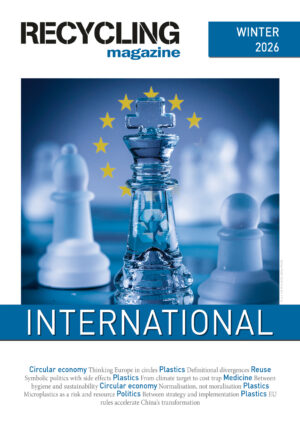
RECYCLING magazine provides independent, deeply investigated information about all aspects of secondary raw materials. The magazine has a long track record, it has a history of more than 70 years. more
RECYCLING magazine is a member of






© DETAIL Architecture GmbH
