

The requirements for recycling electronic waste have increased enormously recently.
Technology
-
-
France’s first industrial plant for automated sorting and recycling of textile waste was officially inaugurated at Nouvelles Fibres Textiles, Amplepuis, on November 30, 2023.
-
MarketTechnology
$13.5 Trillion Investment Needed to Fast-Track Decarbonization of Key Hard-to-Abate Industry Sectors
Transitioning to a more sustainable and carbon-neutral future, $13.5 trillion in investments will be needed by 2050, particularly in the production, energy and transport sectors, according to a new World Economic Forum report.
-
Swiss Krono S.A.S. based in Sully-sur-Loire, the French subsidiary of the Swiss Krono Group, strongly emphasizes the environmental aspects of its activities and is committed to acting more sustainably every day.
-
In this high-tech test center for plastics recycling applications, every recycling process step – from material handling and feeding to extrusion, compounding, pelletizing, material postprocessing and deodorization – can be tested.
-
Plastic waste remains one of the biggest global problems. In an attempt to solve it,
-
MarketPlasticsTechnology
Chromasens SWIR Camera sorts recyclable plastics based on spectral properties
Today, there is an urgent need for innovative techniques to increase plastic recycling.
-
Textiles remain one of the major problems when it comes to recycling, and not just from an environmental perspective.
-
FEAD hosted yesterday a conference on PFAS in the waste sector to analyse the impact of a potential ban.
-
Its enhanced features enable simultaneous flake sorting by polymer, colour and transparency, achieving unmatched quality even from highly contaminated inputs.
-
For the fourth consecutive year, Aimplas presented its sustainability report, prepared in accordance with GRI standards, in which it takes stock of its activity in 2022 based on ESG criteria and renews its commitment to the ten principles of the UN Global Compact and the SDGs.
Next events
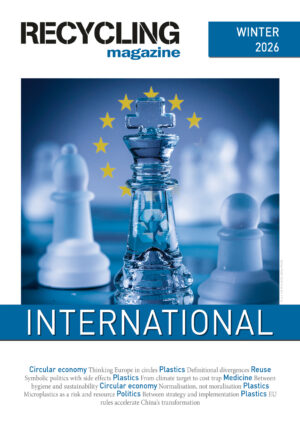
RECYCLING magazine provides independent, deeply investigated information about all aspects of secondary raw materials. The magazine has a long track record, it has a history of more than 70 years. more
RECYCLING magazine is a member of






© DETAIL Architecture GmbH
