
“It is the machine we wanted and the one we helped develop.”
“We always say with a certain sense of pride: It is the machine we wanted and the one we helped develop,” explains Alberto Gallini, Head of GAP Service. The company was involved in testing from an early stage. Together with Sennebogen and Cesaro, numerous detailed improvements were tested, implemented, and integrated into series production. “We noted ten points on the prototype, and in the end all of them were implemented. That’s real added value,” says Gallini.
Energy Efficiency, Throughput, and CO₂ Balance
GAP operates several biomass processing plants in northern Italy, where organic waste materials are converted into energy. Machine performance plays a crucial role: every movement impacts energy efficiency, throughput, and the CO₂ balance.
“We wanted a machine that is built precisely for this process,” says Gallini. “The 360 G is not only powerful but also economical; it directly supports our sustainability strategy.”
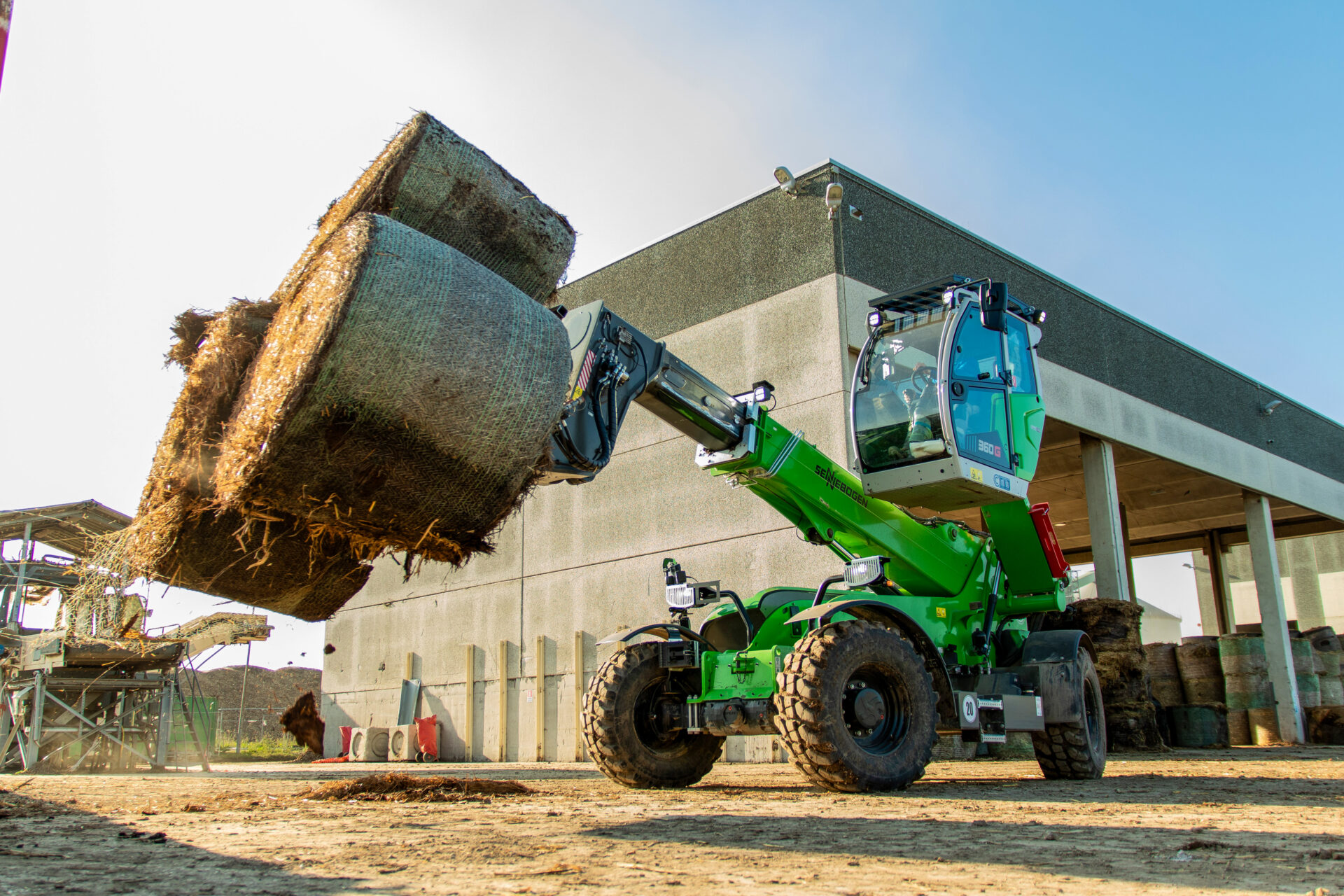
In the biomass facility in Finale Emilia, the 360 G works up to 24 hours a day in three shifts. It handles loading and unloading of organic material, feeds conveyor lines, and compacts bulk material in containers. Thanks to its Z-kinematics, it can easily pick up compacted material. Due to the geometry of the boom combined with the loading linkage, the telehandler achieves up to 20% higher loading density in the container. This reduces transport trips, energy consumption, and emissions—a direct contribution to CO₂ reduction across the entire process chain.
Safety and Efficiency at a Glance
Safety and efficiency in biomass utilization arise from the interaction of several factors:
- Optimal visibility: The cab, which can be raised to 4.25 m, provides a panoramic view of the work area—essential for loading, unloading, and compacting biomass.
- Robust construction: The sturdy design ensures smooth movements and excellent stability, even under continuous load.
- Fast attachment changes: Different tools can be swapped quickly, minimizing downtime.
- Responsive hydraulics: Precise control enables accurate work and increases productivity.
- Ergonomic workplace: The comfortable cab enhances operator concentration and safety. As Marcello Cannavacciuolo, Supervisor at GAP, describes: “I feel absolutely safe in this telehandler. Every movement is precise and stable—the machine gives me confidence.”
Highly Responsive in Continuous Operation
The 360 G operates nearly around the clock in biomass applications. Fast attachment changes and responsive hydraulics ensure short cycle times and high efficiency. “The telehandler reacts quickly, is powerful, and extremely stable—perfectly matched to our requirements,” summarizes Cannavacciuolo.
The 360 G also stands out compared to traditional wheel loaders. “If I can choose between a wheel loader and the 360 G, I always choose the 360 G,” says Gallini. “The telescopic boom, the elevating cab, and the versatility make the difference. The stability is excellent, and the operation feels natural.”
“You buy the service first, then the machine.”
The success of the 360 G speaks for itself: “Our operators don’t even want to use the other machines anymore,” says Gallini. “Two more 360 G units have already been ordered, and we will gradually convert the fleet.”
GAP follows a clear strategy: machines developed from real-world practice offer the greatest long-term benefit. “You buy the service first, then the machine—and if both are right, you stay loyal,” Gallini concludes.
Thus, it becomes clear: safety and efficiency in biomass processing directly depend on visibility, stability, ergonomics, and reliability—key elements for sustainable processes in the circular economy.