
Speira upgrades recycling furnaces in Töging
Speira has commissioned a further new aluminium recycling furnace in Töging, completing four furnace projects at two sites on schedule.

Speira has commissioned a further new aluminium recycling furnace in Töging, completing four furnace projects at two sites on schedule.

The recycling of decommissioned ships still takes place largely outside the EU. The reason for this is often a lack of capacity. However, this does not correspond to reality.

ETH Zurich researchers have developed a patented plastic waste upcycling process that turns polyolefins into a high-performance adhesive.

Political uncertainty, high energy costs and increasing cost pressure do not seem to be leading to a broad withdrawal from decarbonisation.

The supply of gallium is becoming a strategic factor for the energy and semiconductor industries.

The production of high-quality plastic recyclates is time-consuming. This carries the risk of false infor-mation on the quality and proportion of recyclates. Test mechanisms are therefore necessary.

Critical minerals are indispensable for many strategically important applications. Therefore, companies need to make their supply chains more resilient and diverse.

Weak demand, high costs and uncertain EU regulations are putting pressure on plastic recycling. The BIR calls for fair competition and reliable rules.

With the global expansion of photovoltaics and stationary energy storage, the demand for anti-mony is increasing much faster than previously assumed.
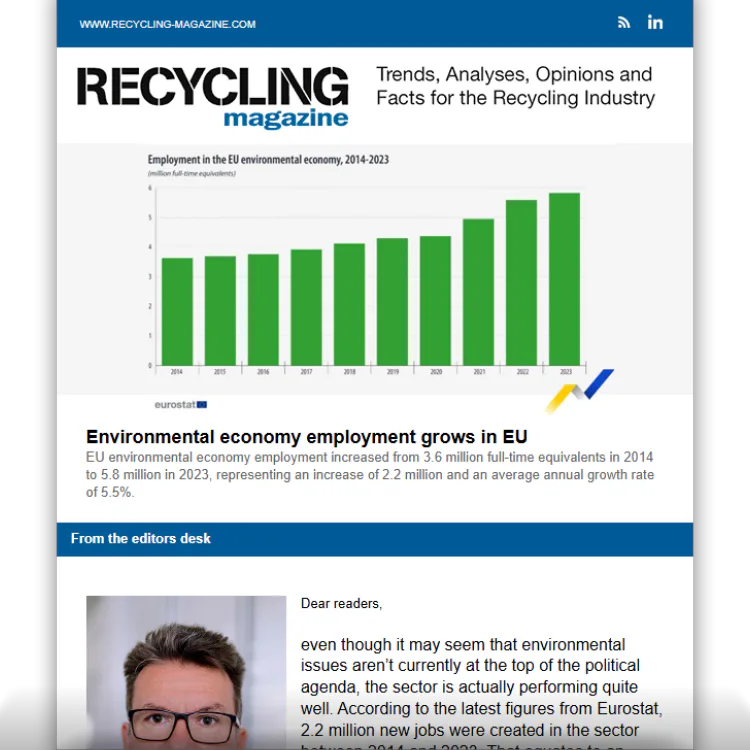

According to FEAD, battery fires caused an estimated €2.66 billion in damage in the EU waste sector in 2025, and incidents are rising.

Indian recyclers have urged the EU to reconsider its Waste Shipment Regulation, which excludes India from a provisional list of approved importers.

Trade barriers are increasingly driven by supply chain security concerns rather than economic or environmental reasons, according to BIR.

Demand for recovered raw materials from electronics is rising. However, inconsistent waste classifications continue to complicate international trade in recycled materials.

With the EU ETS2, the European Union is extending emissions trading to fuels for buildings and road transport for the first time.

A report by the European Environment Agency finds that clean industrial transformation can boost competitiveness, but must accelerate.

Matiq has equipped its Sheffield materials recovery facility with 14 Tomra Autosort units and PolyPerception analysers for real-time visibility.

The public sector steers huge financial flows with its budgets, but environmental and resource effects have so far played only a minor role.

According to model calculations, the increasing copper demand of electromobility can in princi-ple be met by 2050, but with very different consequences for mining, processing capacities and ore grades.

The CO₂ price is considered one of the most important instruments of German climate policy. However, its actual effect is controversially discussed.

Indian recycler RiBotl produces food-grade rPET on a Starlinger bottle-to-bottle system, following FSSAI authorisation in March 2026.

The increasing demand for aluminium in the European automotive industry is increasing the pressure to use more secondary material in demanding vehicle applications.