

The Bureau of International Recycling (BIR) is pleased to announce the arrival of Ms Alexandra Vartan, who joined the BIR advocacy team on 17 March as Policy Officer for Trade & Environment.
General
-
-
PAC2PAC by Bachmann Group describes a closed-loop recycling concept for PET packaging that addresses the ongoing loss of recyclable plastics to thermal treatment. Large quantities of plastic packaging are still not recycled, despite the material value they contain. PET packaging is particularly suitable for circular applications due to its low weight, processing efficiency, recyclability and approval for food contact, as well as its role in extending product shelf life.
-
Eroding vital protections will sideline people and nature, and leave Europe less competitive, less resilient and less sovereign, warns the EEB.
-
In Saint-Étienne, France, Trimetal has established itself as a visionary player in metal recycling. With the installation of Tomra’s -new Finder Color, the company has become one of the first to test this next-generation color sorting technology under real-world conditions. The result: record purity for stainless steel, elimination of manual sorting, and flexibility to process other materials such as copper, brass, and electronic boards.
-
ICIS and CPCIF have released a new study shedding light on the impacts of the European Union’s circularity regulation on global demand for recycled plastics, generally and China’s chemical industries, in particular, with key implications across packaging, automotive, and textiles.
-
Reiling acquired the Swedish company with effect from 1 January 2025.
-
Around 150 professionals gathered in Valencia for two days to review regulatory developments through the insights of 25 expert speakers at the fifth edition of Okplast, organised by Aimplas.
-
In July 2023, the European Commission adopted its proposal to revise and
merge the End-of-Life Vehicles Directive and the 3R Type-Approval Directive
into a single Regulation on Circularity Requirements for Vehicle Design and
on Management of End-of-Life Vehicles. The proposal aims to strengthen the
EU single market while improving the circularity of the sector and reducing
the environmental impacts associated with the design, production, use, and
end-of-life treatment of vehicles. -
As the European Commission’s Joint Research Centre (JRC) works on the development of harmonised End-of-Waste (EoW) criteria for textiles, EuRIC, the voice of Europe’s recycling industries, calls for an approach that is practical, market-driven, and innovation-friendly.
-
Creating a circular automotive sector requires more than just commitments; it demands a robust regulatory framework that promotes fair, transparent practices and ensures the uptake of recycled materials.
-
This initiative is in line with the work the Thermoform team is carrying out in the CEN Standardization WG.
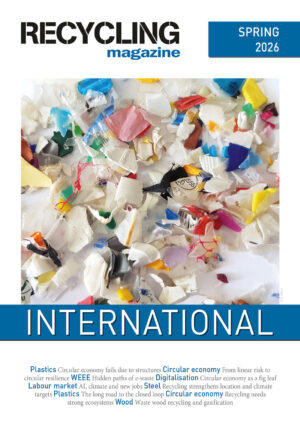
Next events
RECYCLING magazine provides independent, deeply investigated information about all aspects of secondary raw materials. The magazine has a long track record, it has a history of more than 70 years. more
RECYCLING magazine is a member of






© DETAIL Architecture GmbH
