
Subscribe to our newsletter!
Recieve the latest news on recycling, environment and circular economy once a month.

This issue explores how the circular economy can move from ambition to reality. With a focus on building strong recycling ecosystems, it highlights the need for better structures, smarter use of technology, and closer collaboration across industries. From the role of recycling in achieving climate targets to the impact of AI and digitalisation on the sector, this edition shows how circular strategies are becoming essential - not just for sustainability, but also for resilience and future competitiveness.
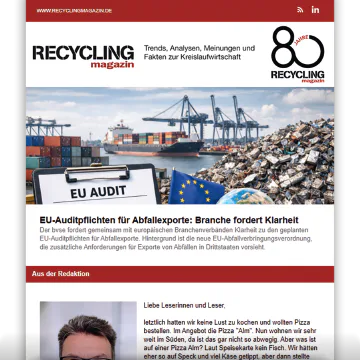

The report "Nature Positive: Role of the Technology Sector" presented by the World Economic Forum positions the digital and technology industries as potentially key players in the protection of biodiversity and natural resources. The report is embedded in the international "Nature Positive" narrative, which has increasingly served as a guiding principle for business and politics since the Kunming-Montreal Global Biodiversity Framework. According to the report, the tech sector should not only reduce its own environmental impact, but also contribute to the ecological transformation of other industries through digitalisation, data availability and efficiency gains. This perspective is ambitious - and of immediate importance for the circular and waste management industry.

The production of information and communication technologies generates high levels of greenhouse gas emissions, while the useful life of many devices is becoming ever shorter. The study "Greenhouse Gas Savings through the Reuse of Selected ICT Devices" conducted by Fraunhofer Umsicht uses a life cycle analysis to investigate the extent to which the reuse and refurbishment of smartphones, tablets, laptops and desktop PCs can contribute to reducing these emissions.

The increasing quantities of waste electrical and electronic equipment are posing considerable challenges for policy-makers, businesses and waste management systems worldwide. An effective circular economy requires that both formal and informal material flows are transparently recorded and quantified. Using the Netherlands as an example, the study "Improving WEEE monitoring: insights from the Netherlands" conducted by Dutch scientists analyses how an almost closed monitoring system for WEEE can be established, which data gaps still exist, and which measures are suitable to improve the recording of informal flows in the future. The study was published in the journal "Resources, Conservation & Recycling".

Japan is considered a recycling pioneer with a high level of technical competence and a pronounced sense of efficiency. But how is the circular economy model developing there beyond conventional recycling? The study "Circular business models in Japan: Analysis of circular business transformation through an institutional approach" conducted by researchers from the Netherlands and Japan shows that the transformation is less disruptive and more cooperative. The study was published in the journal "Sustainable Production and Consumption".

Global supply chains are faltering, commodity prices are fluctuating wildly and regulatory requirements are becoming continuously tighter. Under these conditions, linear business models based on constant resource consumption and short product cycles are increasingly becoming an economic risk. The report "Mitigating linear risks" published by Circle Economy shows that circular strategies have long since ceased to be just a sustainability issue, but are becoming a key instrument of risk management.

Flexible plastic packaging is material-efficient, functional and market-forming, but also technically demanding and economically difficult to recycle. More than half of all plastic packaging is now accounted for by flexible applications, but closed material cycles have so far been the exception. The report "The challenges and solutions for flexible plastic packaging waste" by the "Alliance to end plastic waste" shows which technological, infrastructural and regulatory requirements need to be met in order for problem streams to become resilient value streams.

The circular economy for plastics is politically set, technologically advanced and socially accepted, and yet its success remains limited. There is a structural gap between ambitious targets and the operational reality of the waste management and recycling industry. The article "Decoding the barriers for a circular plastics industry: An equation framework" by a Swedish scientist shows why known barriers have not yet been overcome, why individual measures come to nothing and which systemic prerequisites must be met for plastics cycles to actually work. The article was published in the journal "Sustainable production and consumption".

Digitalisation, artificial intelligence and the ongoing transition to a climate-neutral economy are changing business models, production processes and job profiles worldwide. The World Economic Forum's "Future of Jobs" report shows just how much the labour market is set to change by 2030.

The gasification of residual forestry waste, recycled waste wood, MSW and ligno-cellulosic crop wastes is an emerging pathway to producing liquid fuels. At the high temperatures and pressures in the gasifier, these feedstocks are converted into syngas, a mixture of hydrogen, carbon monoxide and carbon dioxide. Subsequently, the syngas can be converted to methanol or synthetic Fischer Tropsch liquids such as sustainable aviation fuel (SAF). The handling of these non-homogeneous, solid materials is critical to the successful operation of the gasifier to enable a viable recovery and chemical recycling (chemcycling) pathway.
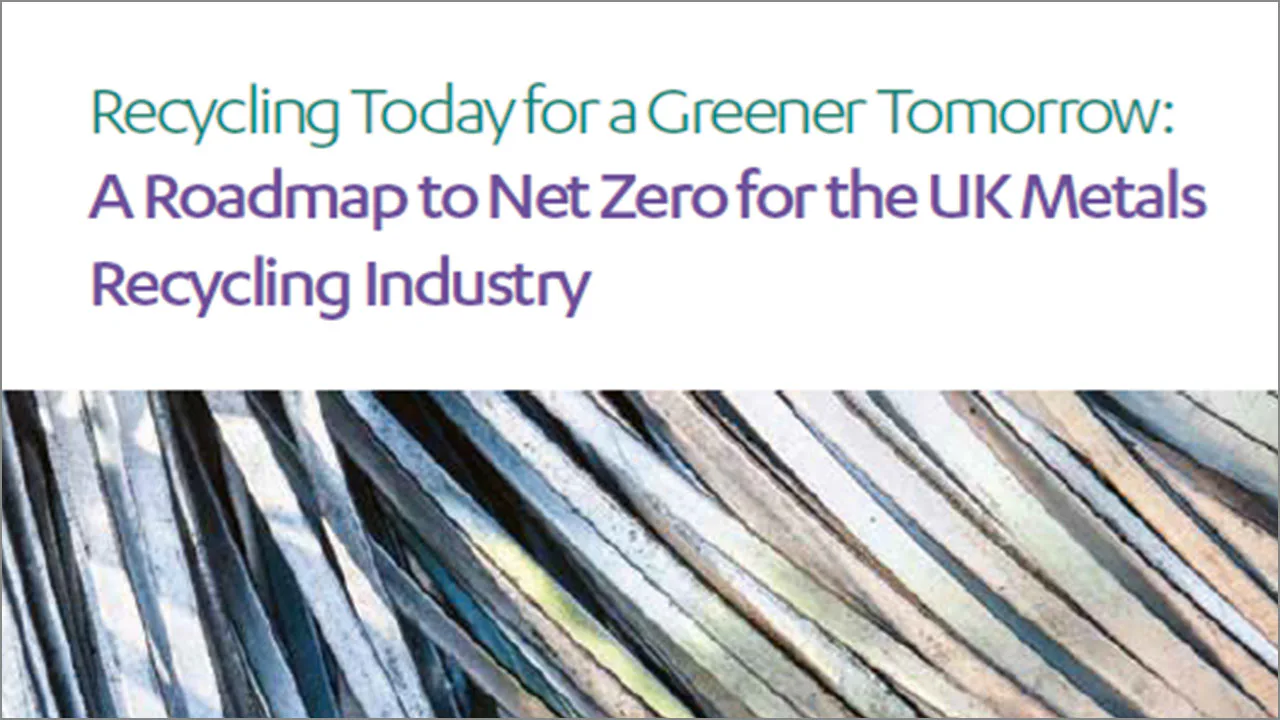
The decarbonisation of industry is decisive for the competitiveness of entire economies. While energy-intensive primary industries are under high pressure to transform, the British Metals Recycling Association's report "Recycling Today for a Greener Tomorrow: a Roadmap to Net Zero for the UK Metals Recycling Industry" shows that the country's metals recycling sector can be a strategic lever for a climate-neutral industrial policy.

Recycling has long been more than just waste recycling. With increasingly strict regulatory requirements, growing recyclate quotas and the pressure to decarbonise, the role of the industry is changing fundamentally. What is needed is not only efficient processes, but also the ability to build and control functioning circular ecosystems. The study "A dynamic capabilities framework for building circular ecosystems by focal firms" conducted by Spanish and Brazilian researchers shows which strategic competencies companies need in order to do so and why recycling companies in particular can play a key role in the process.