
Recycled below value
The export of high-alloy tool steel scrap has been common practice to date, but often leads to the loss of valuable alloying elements in downstream material flows.

The export of high-alloy tool steel scrap has been common practice to date, but often leads to the loss of valuable alloying elements in downstream material flows.

Waste electrical and electronic equipment is one of the most resource-rich waste in the circular economy. Conventional processes for extracting precious metals consume a lot of energy, require aggressive chemicals and are not very selective.

According to Eurostat, in 2024 the EU generated 35.9 kilograms of plastic packaging waste per person and recycled 42.4 percent of it, a slight increase on 2023.

High metal prices, rising energy and transport costs, and increasing trade restrictions are putting pressure on the international non-ferrous metal recycling industry.

The hoped-for recovery of the European plastic recycling market after the summer break has so far failed to materialize.

The international steel scrap market is facing significant changes. While demand for recycled steel is growing in key sales markets, new European export restrictions could disrupt established trade flows.

European waste paper markets are seeing rising prices, even though demand from the paper and packaging industry remains subdued.

The European Union promotes recycling to reduce plastic waste and reduce the use of virgin plastics. Chemical recycling can be an important complement to this, especially for hard-to-recycle plastic waste.

A survey of 10,245 adults in 12 European countries shows Fast Tech is widely owned, while many devices are kept at home or misdisposed.
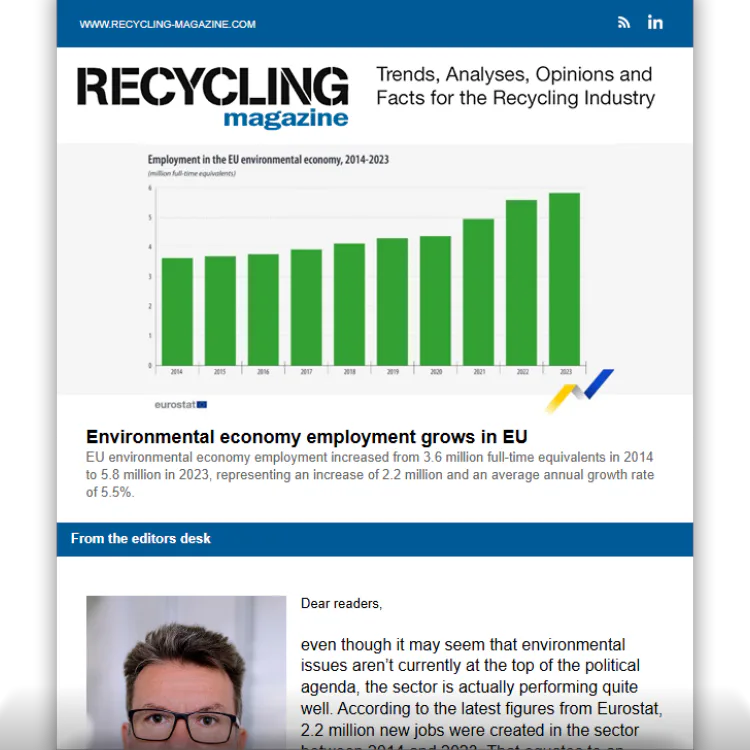

A report by the European Environment Agency finds that clean industrial transformation can boost competitiveness, but must accelerate.

The Bureau of International Recycling asks the European Commission to revise planned export limits for recycled metals and extend its consultation.

The British government wants to fundamentally reposition its steel industry with a clear focus on decarbonisation and the circular economy. At the heart of the UK Steel Strategy is a raw ma-terial that has often been underestimated in the past: steel scrap.

E-waste in Europe keeps growing. NGOs urge the European Commission to strengthen collection, reuse and producer responsibility in the WEEE reform.

The European Environmental Bureau calls for strict environmental reviews of 46 new EU projects for critical raw materials.

The European Commission has selected 46 projects to expand the extraction, processing and recycling of critical raw materials in the European Union.

Researchers at the University of Fukui show that supercritical carbon dioxide redistributes dyes between polyester fibers, creating new shades.

Aimplas leads the VERSO project, which applies the Digital Product Passport and validates reuse systems for plastic packaging.

For years, the material recycling of plastics from end-of-life vehicles has been considered one of the greatest challenges in vehicle recycling.

A three-year European project led by Queen's University Belfast develops human-centred recycling solutions for hazardous work environments.

Plastic packaging waste from the healthcare sector represents a quantitatively relevant recycla-ble material stream that has so far been insufficiently used.

Terms such as upcycling or downcycling are often based less on reliable sustainability data and more on subjective value judgments.