
Michael Brunn
Chefredakteur

Chefredakteur

The necessity of the transformation to a circular economy is hardly questioned anymore. Nevertheless, there is no practical implementation. This applies in particular to the plastics value chain. The problem is that climate neutrality by 2045 requires a completely new set-up of the value chain. However, the necessary investments can hardly be made by the players. In particular, the competitiveness of plastics recyclers is threatened. For this reason, the position paper "Options for a Functional Market for Plastic Recyclates" by the Wuppertal Institute on behalf of the German Federal Environmental Foundation examined the framework conditions required for a sustainable market for plastic recyclates.

The circular economy is considered the key to resource and climate protection. But it has long been an important employment factor. A global survey of "Employment in the Circular Economy" by Circle Economy, the World Bank Group, the International Labour Organization and Page shows that up to 142 million people worldwide work in circular activities.

According to the study "Transforming textile waste into materials using fungi", textile waste streams could no longer be seen primarily as a disposal problem, but as a raw ma-terial basis for new composites. Researchers at the University of Vienna and the Estonian University of Life Sciences have shown that fungal mycelia can combine used clothing to form resilient laminate structures whose mechanical properties are significantly higher than previous mycelium materials. The study was published in "Resources, Conservation & Recycling".

The discussion paper "A post-2030 climate policy framework fit for reaching the EU climate targets" by the German Environment Agency shows that the European climate protection architecture after 2030 must be made much more precise, coherent and resilient in order to actually achieve the goal of climate neutrality by 2050.

Food waste is one of the biggest unsolved problems of European waste management. Despite clear political goals and the obligation to collect organic waste separately, a large part of organic waste remains in residual waste. The study "The case for Extended Producer Responsibility for food products" by Zero Waste Europe and the Bio-based Industries Consortium brings into play an instrument that has long been established in other waste streams: Extended Producer Responsibility (EPR).
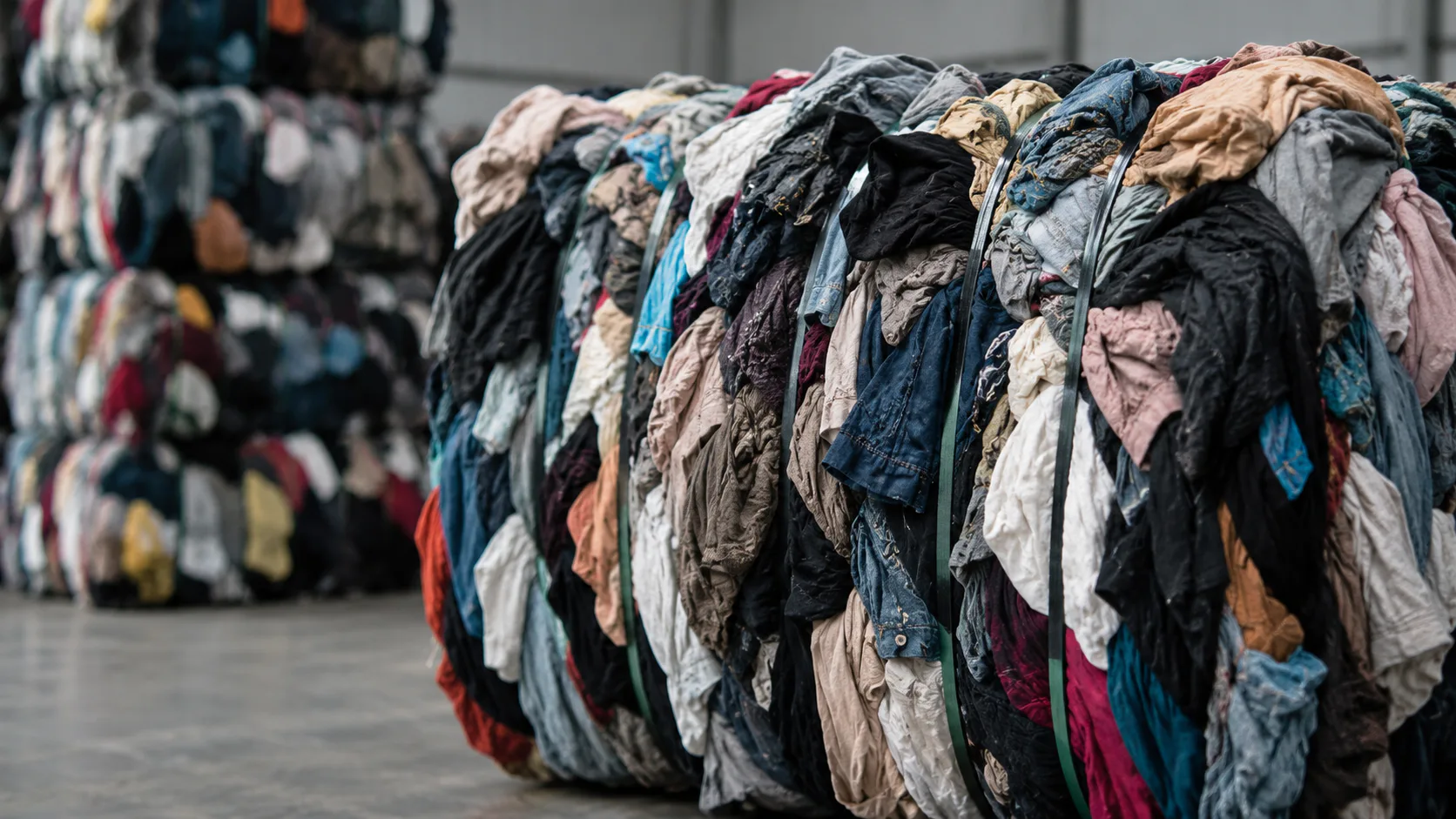
The international recycling industry has urged policymakers to adopt clear and harmonised rules for the transboundary movement of used textiles under the Basel Convention.

With the amendment of the Industrial Emissions Directive, landfills are once again moving into the focus of European environmental policy. The current state of the art shows that modern plants are already making an important contribution to climate protection. At the same time, there is still considerable potential, especially in the case of old landfills. The study "State of the art of waste disposal at landfills in Germany and its contribution to cli-mate protection in preparation for the work for a BAT leaflet on landfills" by IFAS and HiiC-CE on behalf of the Federal Environment Agency presents a comprehensive inventory and shows which technical and regulatory developments will shape the industry in the future.

Food losses cause enormous economic and environmental damage along global supply chains. Avery Dennison's "Making the invisible visible" study finds that around $540 billion in economic losses are generated annually in retail and upstream supply chains alone. New digital technologies promise more transparency about inventories, shelf life and flows of goods.

In a recent report, Zero Waste Europe warns that the EU is also setting the wrong incentives with its textile strategy.

The World Meteorological Organization's global climate data for 2025 show a significant acceleration of key trends from rising greenhouse gas concentrations to record temperatures and a growing energy imbalance in the Earth system. These developments are not without consequences for industrial value chains.